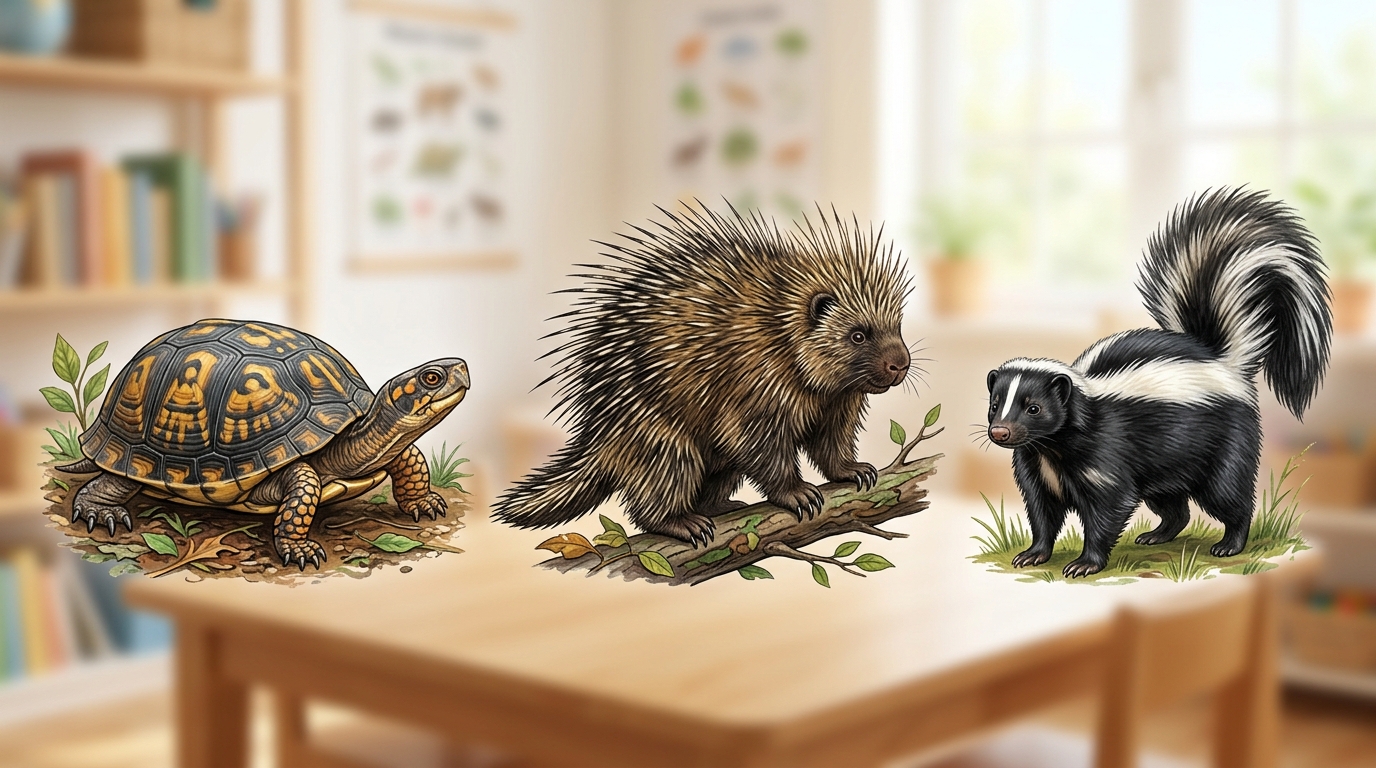
Shells, quills, and warning coloration are different protection structures that help animals avoid harm in different ways.
📋 NGSS Standard: 4-LS1-1 — Construct an argument that plants and animals have internal and external structures that function to support survival, growth, behavior, and reproduction.
🎯 Learning Objective
Students will investigate structures for Protection and Defense, make observations during the lesson activity, and explain what they learned using evidence from the lesson.
Not every survival structure helps an animal move or eat. Many structures protect the body by making the organism harder to bite, harder to grab, or harder to notice.
Protection structures are strong examples of function because students can often infer the job from the shape or covering of the body part.
The Science
Science Snapshot
Defense structures solve different safety problems in different ways.
What is happening?
Protection structures help animals avoid injury or attack. Shells, quills, armor, horns, thick skin, camouflage, and warning colors are all examples of structures linked to defense.
Why it works that way
Some defenses work by preventing a predator from catching the animal, while others work after contact by making the animal hard to eat or dangerous to attack. The best defense depends on the animal’s environment and predators.
Look for this in the lesson
Students should explain the mechanism of protection, not just say a structure “keeps it safe.” Ask whether it hides, blocks, warns, stings, or makes the animal difficult to grab.
Ask while you read: How exactly does this structure lower the animal’s risk of being harmed?
Materials
Gather Before You Start
printed lesson pages and Student Worksheet
lesson hero image or printed animal image cards showing different protection structures
one soft test item like a cracker or soft fruit slice
two or three coverings to test, such as paper towel, foil, felt, bubble wrap, or a plastic lid
pencil
Let's Get Started
Step 1: Open with the turtle, porcupine, and skunk images. Ask which animal would be hardest for a predator to bite, grab, or injure and what visible structure gives that protection.
Step 2: Compare passive protection structures, like shells, with structures that warn or discourage attack, like quills or bold body coloring. Push students to explain how each one lowers danger.
Step 3: Run the protection challenge as the main activity: place a cracker or soft fruit slice inside different coverings—like paper towel, felt, foil, bubble wrap, or a plastic lid—and gently press each one the same way. Ask which covering protects best and what feature made the difference.
Step 4: Connect the test back to animals. Students compare which covering behaved most like a shell, thick scales, or spines and explain which kind of danger each would help reduce.
Step 5: Students complete a table that matches each animal structure to the kind of danger it helps reduce, using both the animal images and the protection challenge as evidence.
Step 6: Close with a short written argument supported by one visible structure clue and one protection function.
Discussion Questions
Q: Why is a shell a strong example of structure and function?Because the shape and hardness clearly connect to protection.
Q: How is a defense structure different from a behavior alone?A structure is a body part; behavior is what the organism does with it.
Q: Can one structure protect in more than one way?Yes, for example thick skin can reduce injury and water loss; coverings can hide and protect.
Extensions
Try a second round of the protection challenge with a new threat: squeezing, dropping, or scraping. Ask whether the same covering still works best and which animal structure it now resembles most closely.
Parent/Teacher Notes
Teaching note: Camouflage can be mentioned only as it connects to body structures or coverings. Keep the lesson centered on body structures, not full ecosystem predator-prey modeling.
🌱 Student Worksheet — Structures for Protection and Defense 🌱
One structure that protects an animal is ... because ...
🔑 Parent Answer Key
Detach note: Student wording may vary if the structure-function science is correct.
What Success Looks Like: Student names a protection structure, explains what kind of danger it helps with, and gives a visible clue.
Acceptable examples: Shell protects soft body parts; quills make predators avoid biting; thick scales add a protective covering; horns can help defend against threats.
Important distinction: If a student writes “the turtle hides,” ask what body structure helps it hide or protect itself.
🥼
This is a preview. Unlock the full lesson.
You're seeing a preview. Full-library access is not live yet. For now, browse the live store products and free sample lessons while the larger subscription offer stays in Coming Soon. Live now: free samples + Kitchen Chemistry.