Life Science — Animal Needs | Unit 3, Lesson 5 of 6
📚 Grade: Kindergarten⏱️ Duration: 30–45 minutes🔬 Subject: Life Science — Animal Needs📋 Unit 3, Lesson 5 of 6
🐦🪹 🐇🕳️ 🐻🏔️ 🐟🪨
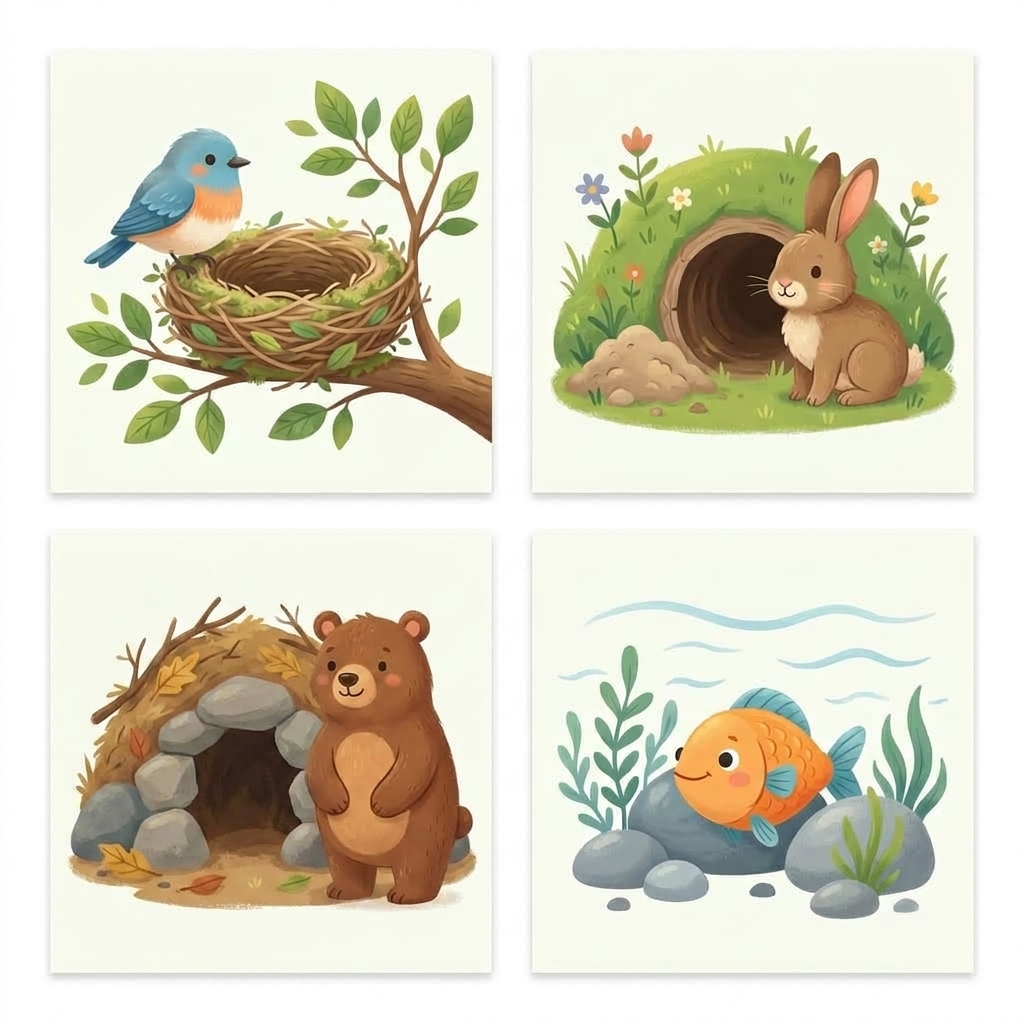
Birds weave nests, rabbits dig burrows, bears find dens — every animal builds or finds a home!
📋 NGSS Standard: K-LS1-1 — Use observations to describe patterns of what plants and animals (including humans) need to survive.
🎯 Learning Objective
Students will BUILD a model shelter for a toy animal using household materials, IDENTIFY at least 2 things a shelter must protect an animal from, and EXPLAIN why their shelter design meets those needs.
💡 The Big Idea
Every animal needs shelter to survive. A shelter is a safe place that protects animals from weather (rain, cold, wind), hides them from predators (animals that might eat them), and gives them a cozy place to rest and raise their babies. Without shelter, animals would be cold, wet, and in danger.
💡 Key Vocabulary: shelter, predator, protection, den, burrow, nest, habitat
🔬 The Science
Animals can't just live anywhere — they need a habitat that provides food, water, AND shelter. Different animals build or find very different shelters depending on their size, their predators, and the weather in their home environment. A bird's nest is made of twigs and held high in a tree. A rabbit's burrow is dug deep underground. A bear's den might be a cave or a hollow log. A fish might hide inside an underwater cave or rocky crevice. All of these shelters do the same important jobs — they keep the animal safe, dry, and comfortable.
🏠 Connect to humans: Our houses are our shelters too! A roof keeps us dry. Walls keep out the wind and cold. Locks keep us safe. We're animals too — we just build fancier homes!
📦 Materials
🧸 You'll Need a Toy Animal
Any small toy: bird, rabbit, bear, fish, or similar
A stuffed animal works great too!
🏠 Household Building Supplies
Cardboard boxes (any size)
5–10 small sticks or twigs (pencil-length), collected from outdoors. No yard? Use toothpicks, wooden coffee stirrers, or pipe cleaners instead!
Yarn or string
Cotton balls
Towels or felt pieces
Leaves, paper crumples, or brown craft paper
Tape and scissors
A bowl or bin (for fish option)
A spray bottle with water (for shelter testing!)
🔬 Let's Get Started
Step 1 — What Is a Shelter? (5 min)
Start with a question: "What does a bird need to survive? What about a bear? What about a rabbit?"
After students name food and water, ask: "What about a safe place to sleep? A place to have babies? A place to hide from danger? That's called a SHELTER."
Show pictures or draw simple sketches of: a bird nest, a rabbit burrow, a bear den, a fish cave. Let kids identify them.
Step 2 — Choose Your Animal (3 min)
Each student picks a toy animal and decides what kind of shelter it needs:
Gemini visual guide: nest, burrow, den, and fish hiding spot.
🐦 🪺 ☁️
Bird → Nest
Use sticks, yarn, and cotton balls to make a soft nest.
Soft + up high
🐇 🕳️ 🌿
Rabbit → Burrow
Drape towels over a box to make a tunnel home.
Hidden + cozy
🐻 🪵 ⛰️
Bear → Den
Use a box, brown paper, and a few sticks to make a den that feels dark and protected.
Warm + dark
🐟 🪨 🌿
Fish → Hiding Spot
Build a fish hiding place with a cup, "rocks," and plants.
Rocks + plants
Step 3 — Build the Shelter! (10–15 min)
Using ONLY household materials, build the shelter for the chosen animal. Encourage kids to:
Think about the SIZE — can the animal fit inside?
Think about COVERING — is there a roof or walls?
Think about SAFETY — would this help keep the animal safe from danger?
Add a space for "babies" — make it big enough for a family!
Fish note: This fish activity is a dry model. The cup stands for a rocky underwater hiding place, and the paper/plants stand for rocks and water plants.
"Real animals are incredible engineers. You are too!"
Step 4 — Test the Shelter! (5–10 min)
Now it's time to see if the shelter really works. Run each test:
🧪 Shelter Test Checklist
🌧️ "Rain" test: Lightly sprinkle water near the shelter with a spray bottle. Does the animal stay dry?
🐣 "Baby" test: Could another small toy animal fit inside? Is there room for a family?
👁️ "Safety" test: Does the shelter help keep the animal safe from danger? It can be hidden, hard to reach, or protected by strong walls.
If a test fails, IMPROVE the shelter! Real animals do this too — they adjust and rebuild.
Step 5 — Share & Discuss (5 min)
Each child presents their shelter. Ask: "What did you build? What does it protect your animal from? What would you change to make it even better?"
💬 Discussion Questions
🗣️ Question 1: "What would happen if a bird didn't have a nest?"
Without a nest, a bird's eggs would fall to the ground and break, and baby birds would be exposed to rain, cold, and predators. The nest keeps the family safe, warm, and together — it's like a nursery and a fortress!
🗣️ Question 2: "Humans build houses for shelter. What's one thing a human house does that an animal's shelter also needs to do?"
Both need to keep out rain, cold, and wind — provide safety from danger — and have space for the family! Animals are clever builders: beavers build dams, birds weave nests, some fish dig holes in sand. We're not so different from animals after all!
🚀 Extensions
🦫 Beaver Dam Challenge: Can you build a dam with sticks across a shallow tray of water? Will it hold? Beavers do this to make a safe pond for their lodge!
🕸️ Spider Web Hunt: Go outside and find a spider web. What materials did the spider use? How is it like a shelter?
📚 Read Aloud:"A House Is a House for Me" by Mary Ann Hoberman — a classic exploration of all kinds of animal homes!
🗺️ Animal Home Map: Draw a neighborhood — but for animals! Where does the bird live? The rabbit? The bear? Label each home.
🏘️ Real vs. Model: Look up pictures of real bird nests, beaver dams, and termite mounds. How close did your model get?
👩🏫 Parent/Teacher Notes
All household materials — nothing to buy. Sticks and twigs from the yard are perfect for bird nests. Boxes, brown paper, and leaves work well for bear dens.
This is an engineering activity as well as science. When students test their shelters and find they fail, encourage them to iterate and improve — that's real science and engineering thinking. Failure is part of the process!
Connect back to humans: Our houses are our "shelters" too — what does our house protect us from? Rain, wind, cold, danger? Help kids see that humans and animals have the same survival needs.
Discuss different real animal shelters: birds' nests, beaver dams, rabbit burrows, spider webs, termite mounds, prairie dog towns. Each one is perfectly designed for that animal's needs.
Vocab to reinforce: shelter, predator, protection, den, burrow, nest, habitat
Assessment tip: Can the child name at least two things a shelter protects an animal from? Can they explain why their shelter works (or what it needs to work better)? That's the learning goal.
📝 Parent Note: This worksheet is picture-based and circle-based for kindergarten. Read the choices out loud and let your child point, circle, or tick.
✏️ Task 1 — Draw your shelter!
Draw your shelter with your animal inside.
⭕ Task 2 — Circle your animal:
🐦 Bird
🐇 Rabbit
🐻 Bear
🐟 Fish
✅ Task 3 — Tick what your shelter does:
☐ Keeps my animal dry
☐ Keeps my animal warm
☐ Keeps my animal safe
☐ Gives my animal a place to rest
✂️ PARENT/TEACHER ANSWER KEY — Detach before giving worksheet to students
💬 Discussion Question 1
Q: "What would happen if a bird didn't have a nest?"
A: Without a nest, a bird's eggs would fall to the ground and break, and baby birds would be exposed to rain, cold, and predators. The nest keeps the family safe, warm, and together — it's like a nursery and a fortress!
💬 Discussion Question 2
Q: "Humans build houses for shelter. What's one thing a human house does that an animal's shelter also needs to do?"
A: Both need to keep out rain/cold/wind, provide safety from danger, and have space for the family. Animals are incredibly clever builders — beavers build dams, birds weave nests, some fish dig holes in sand. Humans and animals share the same core survival needs!
✅ Worksheet Checkboxes
What to look for: The child should be able to tick at least one true shelter function, ideally two or more: keeps the animal dry, warm, safe, or gives it a place to rest.
🧪 Shelter Test Expectations
🌧️ Rain test: The shelter should provide cover. If it doesn't, guide the student to add a "roof" layer (a box lid, extra towel, or leaves).
🐣 Baby test: If the shelter is too small, encourage expanding it. Real animals often enlarge their nests/burrows as their family grows!
👁️ Safety test: If the shelter does not seem safe, encourage adding walls, cover, or a more protected entrance. Some shelters are hidden, but others are safe because they are strong or hard to reach.
✅ What Success Looks Like
Student built a shelter that covers/hides the animal in some way
Student can name at least 2 things a shelter protects an animal from
Student can show at least one way the shelter helps the animal stay safe, dry, warm, or rested
Bonus: Student made at least one improvement after a failed test
🐾 Real-World Animal Shelter Reference
🐦 Bird nest: Woven from twigs, grass, mud — keeps eggs warm and off the ground
🐇 Rabbit burrow: Tunnels underground — warm, hidden from foxes and hawks
🐻 Bear den: Cave, hollow log, or dug-out space — for hibernating through winter
🐟 Fish hiding spot: Underwater plants and rocks — hides from larger fish predators. Model: cup + crumpled paper (rocks) + plant sprigs
🦫 Beaver lodge: Built from sticks and mud in the middle of a pond — entrance is underwater for protection!
🕷️ Spider web: A trap AND a home — some spiders hide in curled leaves attached to their web
🐜 Termite mound: Can be taller than a human — temperature-regulated inside!