Decomposers help matter move back into the ecosystem.
📋 NGSS Standard: 5-LS2-1 — Develop a model to describe the movement of matter among plants, animals, decomposers, and the environment.
🎯 Learning Objective
Students will explain how decomposers break down dead matter and return materials to the environment.
💡 The Big Idea
Decomposers are nature’s recyclers. They help matter move through the ecosystem instead of staying locked in dead material.
🔬 The Science
Science Snapshot
Decomposers help move matter back into forms that other organisms can use again.
What is happening?
Decomposers such as fungi, bacteria, and some invertebrates break down dead organisms and waste. They are essential because matter in an ecosystem is recycled rather than used once and lost forever.
Why it works that way
As decomposers feed, complex materials are broken into simpler substances that return to soil, water, and air. Those materials can then be used again by plants. Without decomposition, dead matter would pile up and nutrients would stay trapped.
Look for this in the lesson
Students should distinguish energy from matter here. Energy flows and is released as heat, but matter is rearranged and reused inside the ecosystem.
Ask while you read: What would happen to an ecosystem if decomposers suddenly disappeared?
📦 Materials
🏠 Household Items to Gather
Leaf litter, compost, a fallen log photo, or another example of decaying material
Worksheet and pencil
Crayons or colored pencils
Optional: scissors for decomposer sort cards
📋 Printables
Student worksheet page from this lesson
Decomposer sort cards page from this lesson
🧪 Investigation
🍂 Decomposer detective challenge: Students inspect a real or pictured example of decay, sort possible decomposers from non-decomposers, then build a matter-cycle model that shows exactly how dead material gets reused in the ecosystem.
Step 1 — Observe decay closely (8–10 min) Show leaf litter, compost, a fallen log, or the decomposition photo from this lesson. Students record what they notice: color changes, softness, crumbling pieces, fungi, insects, moisture, and smell if appropriate. Ask: What evidence shows this material is changing?
Step 2 — Sort the possible decomposers (8–10 min) Use the decomposer sort cards to decide which organisms help break down dead matter and which do not. Include debate. Students must justify each choice using evidence, not guesses.
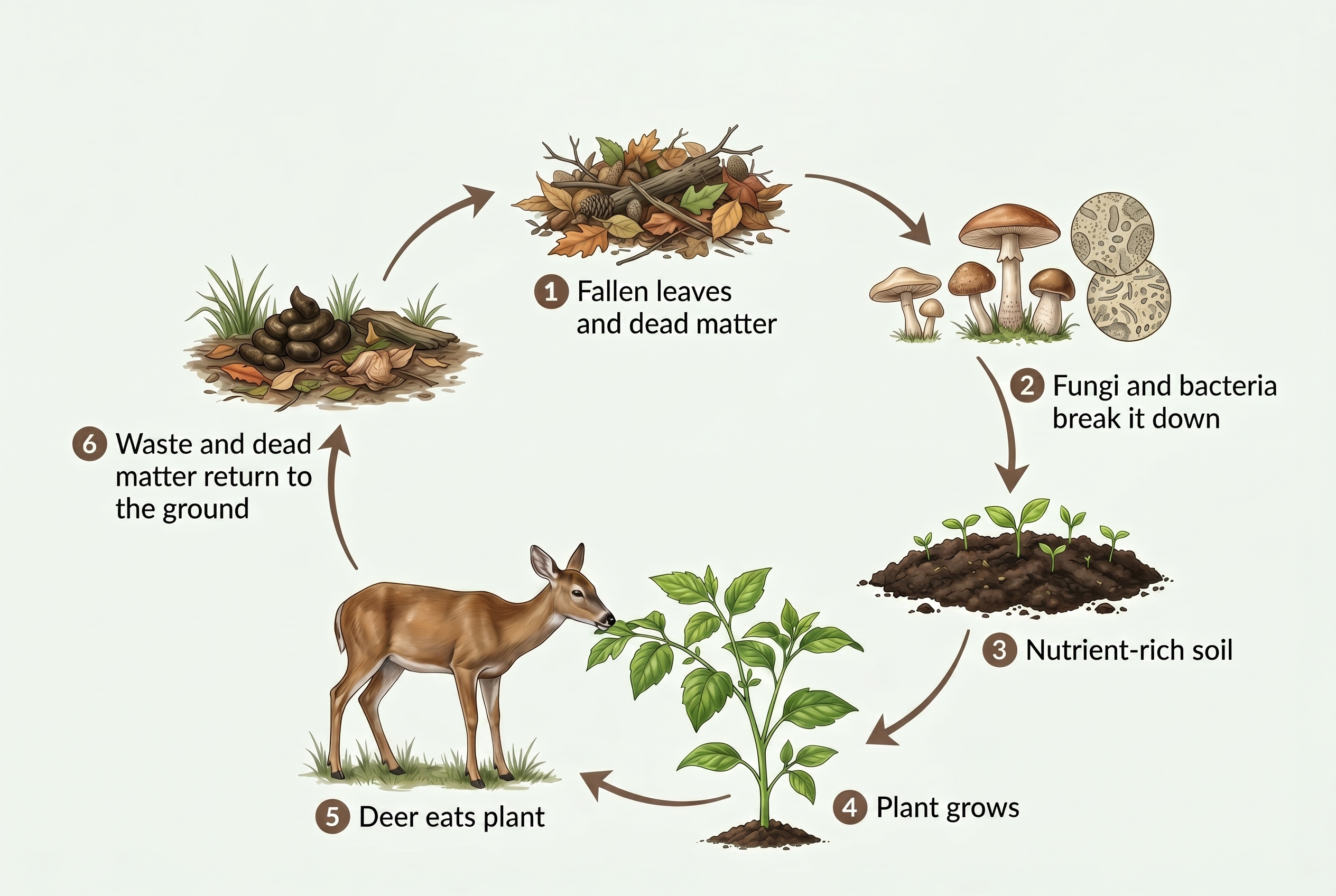
Step 3 — Trace where the matter goes (10–12 min) Pick one example, such as a dead leaf. Students explain the path: dead leaf → decomposers break it down → nutrients return to soil → plant uses nutrients → animal eats plant. This answers not just where matter goes, but how it gets there.
Step 4 — Build the matter cycle model (10–15 min) Students create a diagram that includes dead matter, decomposers, soil nutrients, producers, and consumers. They draw arrows and label what is moving through the system.
Step 5 — Explain the ecosystem payoff (8–10 min) Students explain why ecosystems would not work well without decomposers and what would happen if dead matter never broke down.
💬 Discussion Questions
What do decomposers do?They break down dead material and waste.
How do decomposers help plants?They return nutrients to the environment.
Why is this called recycling matter?The matter gets used again in new parts of the ecosystem.
🚀 Extensions
Extension: Go outside and look for evidence of decomposition in a place you can safely explore, such as a leaf pile, garden bed, under a shrub, near a tree, a compost bin, a fallen log, or damp soil. If you do not have access to those, check a houseplant pot, a yard waste bin, old mulch, or photos and videos of forest floor decay. Record what you see, what might be breaking the material down, and what clues tell you matter is being recycled.
👩🏫 Parent/Teacher Notes
Teaching move: Students may know “gross” examples like mold. Use that engagement to reinforce the ecosystem payoff.
From the cards or examples, circle the organisms that help break down dead matter. Then explain one choice.
3️⃣ Draw the recycling cycle
4️⃣ Explain the science
Why are decomposers necessary in an ecosystem?
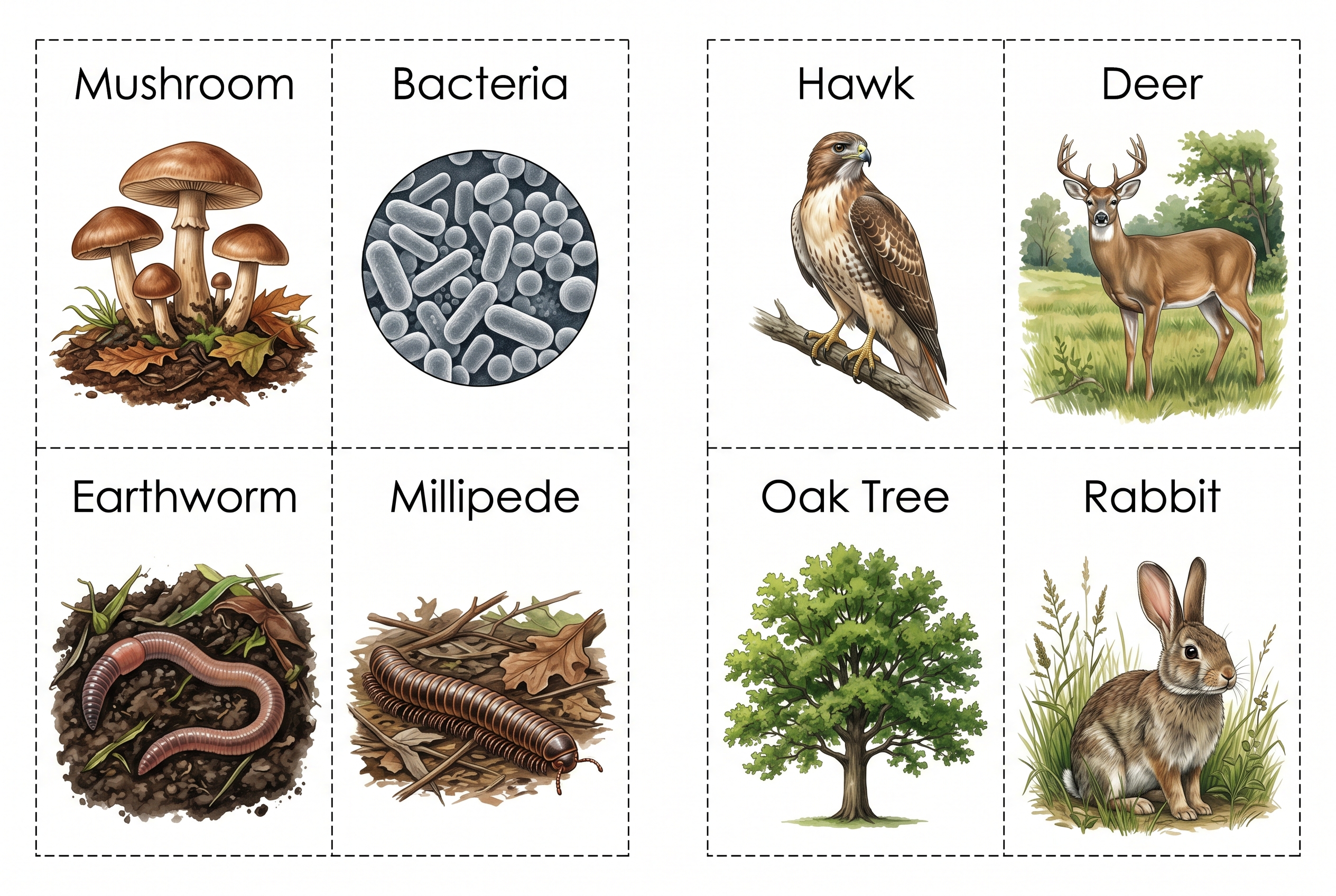
✂️ Decomposer Sort Cards
Cut out the cards above. Sort which organisms help break down dead matter and which do not.
🔑 PARENT ANSWER KEY — Detach before giving worksheet to students
Sample Explanation
Decomposers break down dead matter and return nutrients to soil or water, where producers can use them again. A correct cycle might look like this: dead leaf → fungi, bacteria, and detritivores break it into smaller parts → nutrients return to soil → plant roots absorb nutrients → an herbivore eats the plant → matter continues moving through the ecosystem.
✅ What Success Looks Like
Student identifies decomposers correctly.
Student explains how decomposition returns nutrients to the environment.
Student includes dead matter, decomposers, soil nutrients, producers, and consumers in the cycle model.
Student connects decomposition to matter cycling.
Suggested decomposers from the sort cards
Correct decomposer examples: mushroom, bacteria
Helpful detritivores that support decomposition: earthworm, millipede
Not decomposers: hawk, deer, oak tree, rabbit
Sample matter cycle
An example decomposition cycle for parents to reference during the activity.
🥼
This is a preview. Unlock the full lesson.
You're seeing a preview. Full-library access is not live yet. For now, browse the live store products and free sample lessons while the larger subscription offer stays in Coming Soon. Live now: free samples + Kitchen Chemistry.