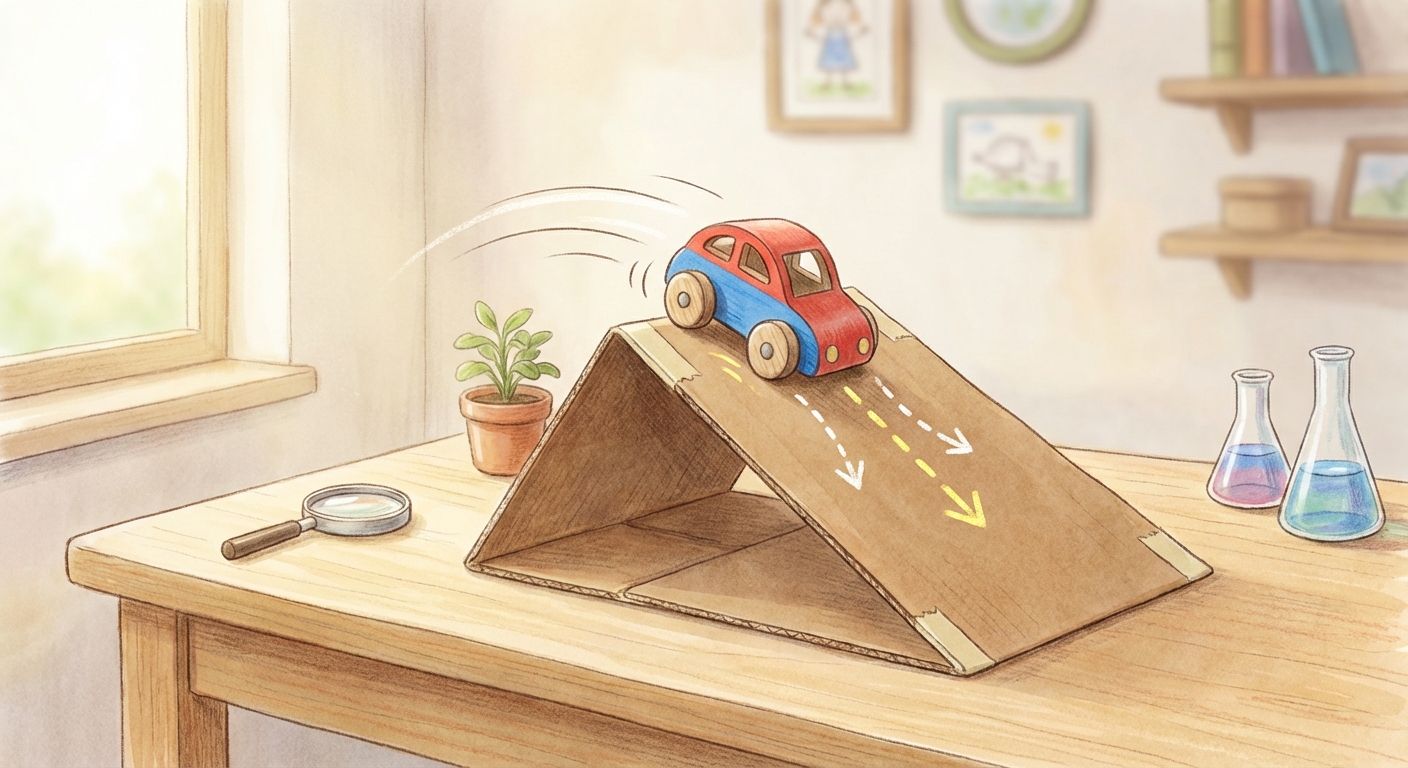
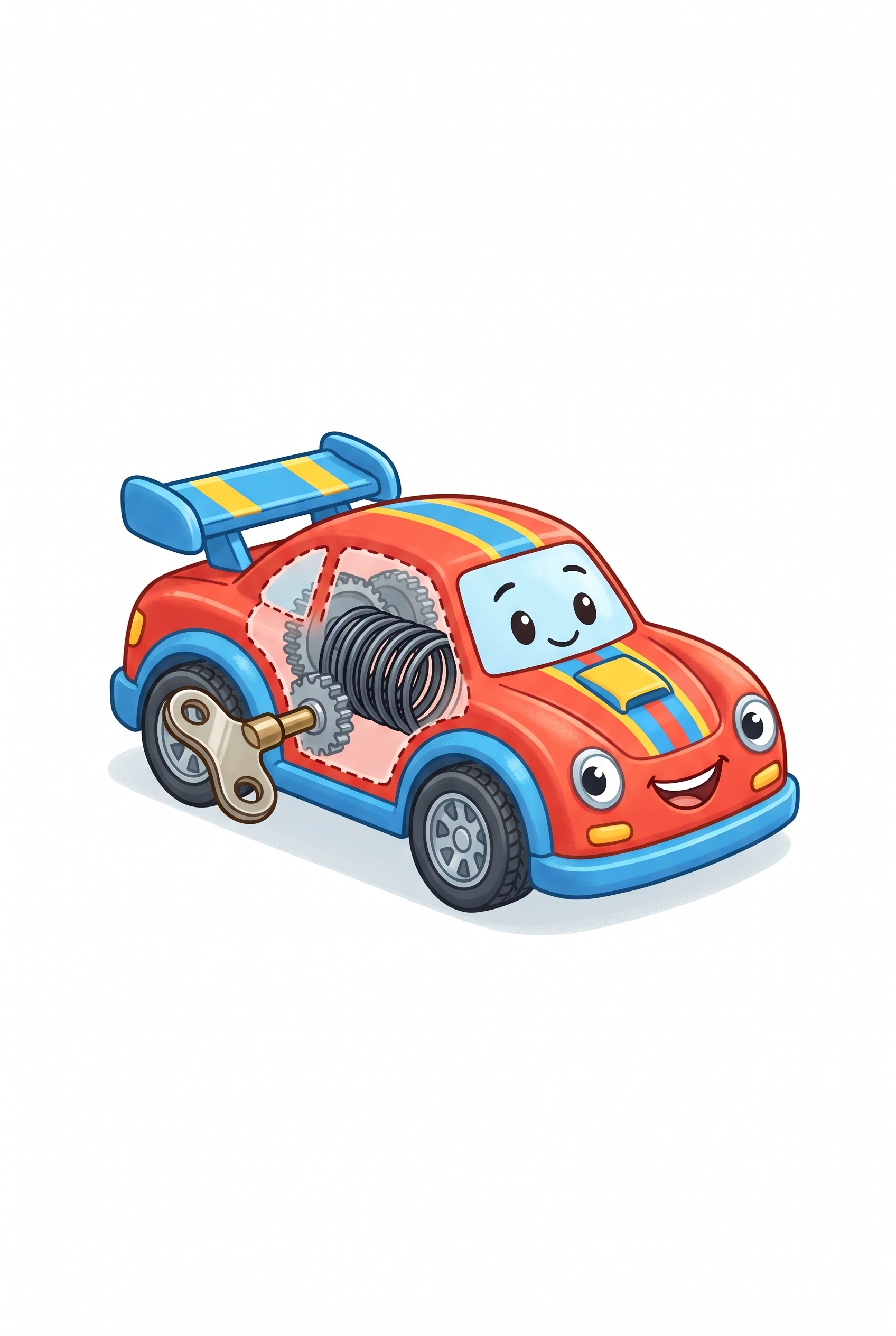
A higher starting position can give a toy car more energy and help it move faster when released.
📋 NGSS Standard: 4-PS3-1 — Use evidence to construct an explanation relating the speed of an object to the energy of that object.
🎯 Learning Objective
Students will compare a low ramp start and a high ramp start, then explain with evidence how a higher start can give the same object more energy and change its speed.
💡 The Big Idea
When the same object starts with more stored energy, it can move faster and travel farther. Scientists use fair comparisons, repeated trials, and careful observations to connect the object’s speed to the energy it had at the start.
🔬 The Science
Science Snapshot
Motion can begin when stored energy is released into a moving system.
What is happening?
Stored energy can become motion when it is released from a stretched, compressed, wound, or raised system. A rubber band, a spring, or an object held up high can all store energy that later causes motion.
Why it works that way
The energy is not created at the moment of release; it was stored earlier when the object was stretched, lifted, or otherwise prepared. Motion begins when that stored energy is transferred into kinetic energy.
What makes this a fair test?
If students keep the same car, ramp, surface, and release method, then starting height is the important change. That makes it more reasonable to connect a speed difference to a difference in stored energy.
Ask while you read: Where was the energy stored before the object started moving, and what evidence would show that more starting energy changed the car’s speed?
🃏 Stored Energy System Cards
Use these cards to compare different systems that can store energy before motion starts.
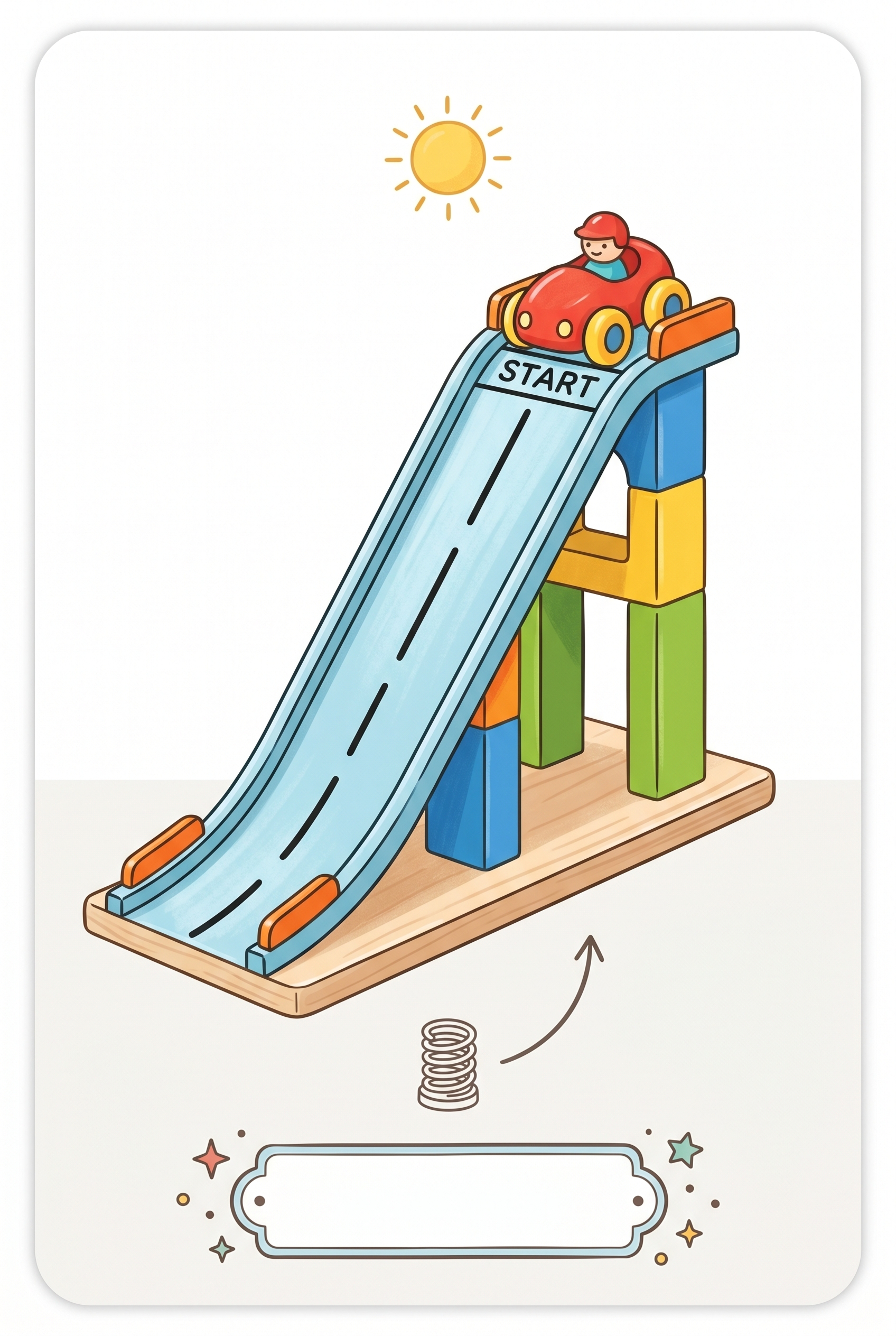
Raised ramp
Energy is stored because the object starts higher.
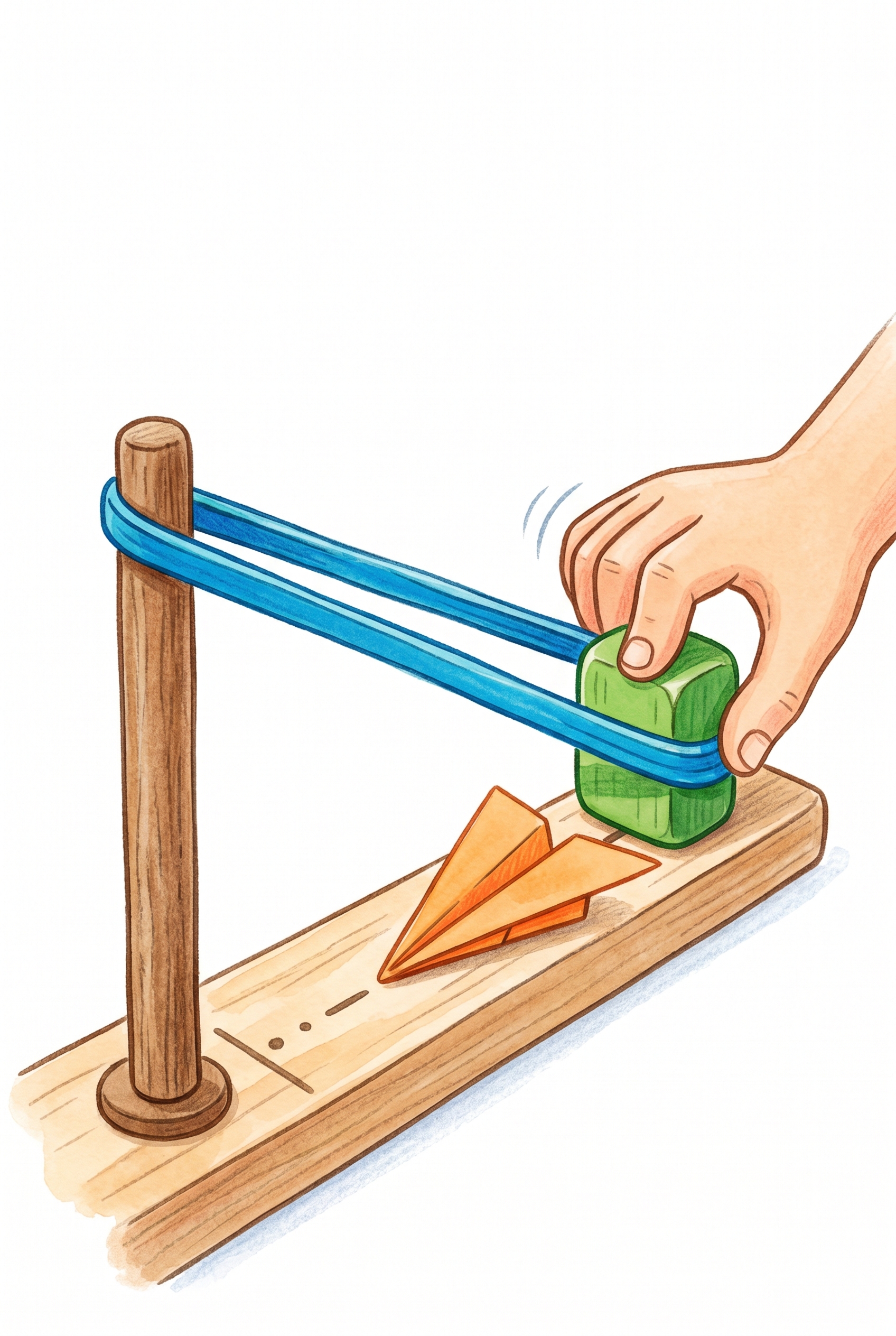
Stretched rubber band
Energy is stored when the band is stretched.
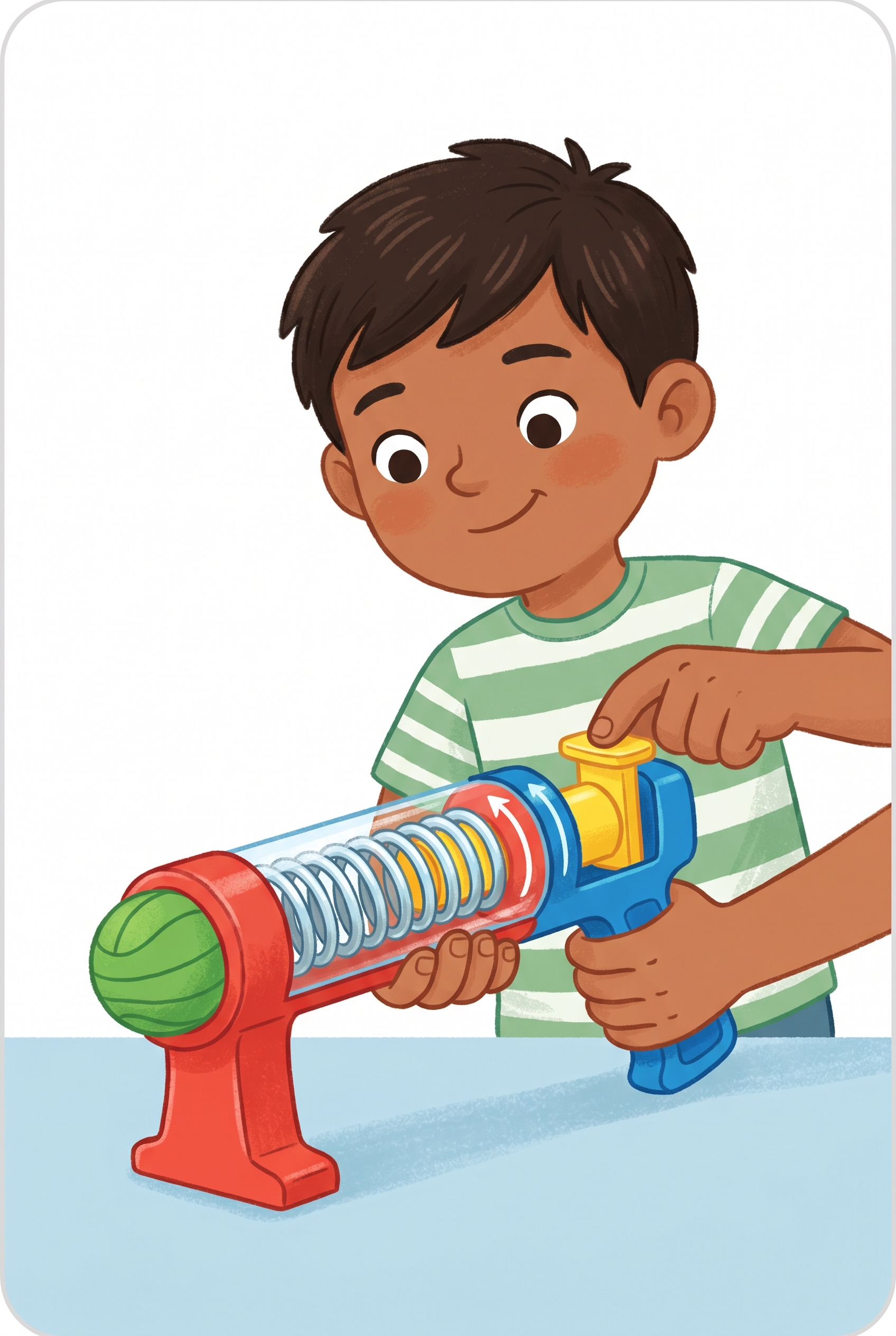
Compressed spring
Energy is stored when the spring is squeezed.
Wound-up toy
Energy is stored when the toy is wound up.
📦 Materials
🏠 Household Items to Gather
One toy car, marble, or small rolling object
One piece of cardboard, a cookie sheet, or a smooth board for a ramp
Two or three books or blocks to change ramp height
One rubber band and a safe small object to launch or flick gently (optional comparison system)
Masking tape for start and finish lines
Ruler or tape measure
Worksheet and pencil
📋 Printables
Student worksheet page from this lesson
🧪 Investigation
Step 1 — Build one ramp, two start heights (5–10 min) Set up one ramp with a low release point and a higher release point. Use tape to mark the two starting spots so the object can be released from the same places each time.
Step 2 — Make a prediction (5 min) Before releasing the car, students predict which start will be faster and explain why. Encourage them to use the words stored energy, motion, and fair test.
Step 3 — Test the low start first (10 min) Release the car without pushing it. Watch how quickly it moves and where it stops or how far it rolls after leaving the ramp.
Step 4 — Test the higher start (10 min) Keep the same car and ramp, but release the car from the higher mark. Compare the speed and distance with the low-start test.
Step 5 — Repeat and record evidence (10 min) Repeat both starts at least twice. Students should record what stayed the same, what changed, and which start led to faster motion.
Step 6 — Add a fun challenge (5 min) Place a paper cup or block target near the bottom and ask which start is more likely to bump it harder or push it farther. Students should predict first, then test if time allows.
Step 7 — Compare a second energy system (5–10 min) Show a stretched rubber band as another way to store energy. Ask students how this system is similar to the higher ramp start and how it is different. If safe and available, do one quick test by releasing the rubber band to move a light object.
Step 8 — Explain the pattern (10 min) Use evidence from the fair test to explain how the higher start gave the car more energy and changed its motion. Then connect that idea to another stored-energy system, such as the rubber band.
💬 Discussion Questions
What stayed the same in this fair test?Look for: the same car, the same ramp, and the same surface. Only the starting height changed.
What evidence suggests the higher start gave the car more energy?Look for: the car moved faster, rolled farther, or reached the end sooner when it started higher.
Why should you release the car instead of pushing it?A push would add another change and make it harder to tell whether the starting height caused the difference.
If two tests gave different results, what should you check?Students should think about whether the same car, same ramp, same release, and same surface were really kept the same.
How is a stretched rubber band similar to a higher ramp start?Both systems store energy before motion begins, then release that energy into motion.
How does this lesson connect to motion?Energy at the start can change how fast an object moves and how much motion it has later.
🚀 Extensions
Extension: Add a paper-cup target at the bottom of the ramp and compare which starting height makes a bigger motion change when the car reaches the target. This sets up the next lesson on collisions.
👩🏫 Parent/Teacher Notes
Teaching move: Keep the language concrete: higher start, faster motion, farther roll, same car, same ramp.
Misconception to catch: Students may say the higher start worked because you "pushed it more." Remind them that the release was the same; the stored energy came from the higher starting position, not from an extra hand push.
Before you test, which start do you think will be faster? Why?
2️⃣ Compare the two starts
Ramp start
What did you observe?
Did it move faster, slower, or about the same?
Low start
High start
Second low-start trial
Second high-start trial
3️⃣ What stayed the same? What changed?
4️⃣ Explain the pattern with evidence
Use this sentence frame if you want: The higher start gave the car more energy because... Make sure you name which start was faster and one thing that stayed the same in the fair test.
5️⃣ Challenge question
If the higher start made the car hit a paper cup harder, how would that support the idea that it had more energy?
6️⃣ Compare a second energy system
How is a stretched rubber band similar to the higher ramp start? How is it different?
7️⃣ Draw the ramp setup
🔑 PARENT ANSWER KEY — Detach before giving worksheet to students
Sample observation pattern
Answers vary, but the same car should usually move faster or travel farther from the higher starting point than from the lower starting point.
Prediction
Students should usually predict that the higher start will be faster because it begins with more stored energy.
What students should name in Part 3
Stayed the same: the same car, ramp, surface, and release method
Changed: the starting height on the ramp
Sample explanation
The high start gave the car more stored energy. My evidence is that the same car rolled faster and farther when it started higher on the same ramp. The car and ramp stayed the same, so the starting height was the important change. That evidence supports the idea that more starting energy changed the car’s speed.
Challenge question
If the higher start made the car hit a paper cup harder, that would support the idea that it had more energy to transfer when it collided.
Second system comparison
Students should notice that a stretched rubber band also stores energy before release. A strong answer explains that both systems store energy before motion begins, but they store it in different ways.
✅ What Success Looks Like
Student compares low and high starts using the same car and ramp.
Student names both an observation and a cause-and-effect explanation.
Student explains that the higher start, not an extra push, caused the speed difference.
🥼
This is a preview. Unlock the full lesson.
You're seeing a preview. Full-library access is not live yet. For now, browse the live store products and free sample lessons while the larger subscription offer stays in Coming Soon. Live now: free samples + Kitchen Chemistry.