Daily weather can change, but a detailed weather record helps students notice patterns over several days.
📋 NGSS Standard: 3-ESS2-1 — Obtain and combine information to describe climates in different regions of the world.
🎯 Learning Objective
Students will record weather observations over several days and describe a short-term weather pattern using evidence.
💡 The Big Idea
Weather can change from day to day, but a weather record helps us notice repeated patterns like rainy afternoons, cooler mornings, or windy days after a storm.
🔬 The Science
Science Snapshot
A pattern is something that happens again and again across repeated observations.
What is happening?
Weather patterns are changes we can notice when we record conditions such as temperature, wind, clouds, and precipitation over many days. One day of weather is a snapshot; a pattern appears only when we collect repeated observations.
Why it works that way
Scientists use patterns to make better predictions. If afternoons are often warmer, or if certain clouds usually come before rain, those repeated clues help explain and anticipate local conditions.
Look for this in the lesson
Students should think like observers who are building evidence across time. The important move is comparing records rather than judging weather from a single moment.
Ask while you read: What repeated clue makes this weather event part of a pattern instead of a one-time surprise?
Materials
🏠 Household Items to Gather
Printed lesson pages and worksheet
Pencil and colored pencils
The included 5-day weather record on this lesson page
Optional: local weather app for checking the real forecast
Optional: simple homemade tools like a wind vane and a rain cup marked in millimeters
📋 Printables
Student Worksheet page from this lesson
Weather Observation Reference
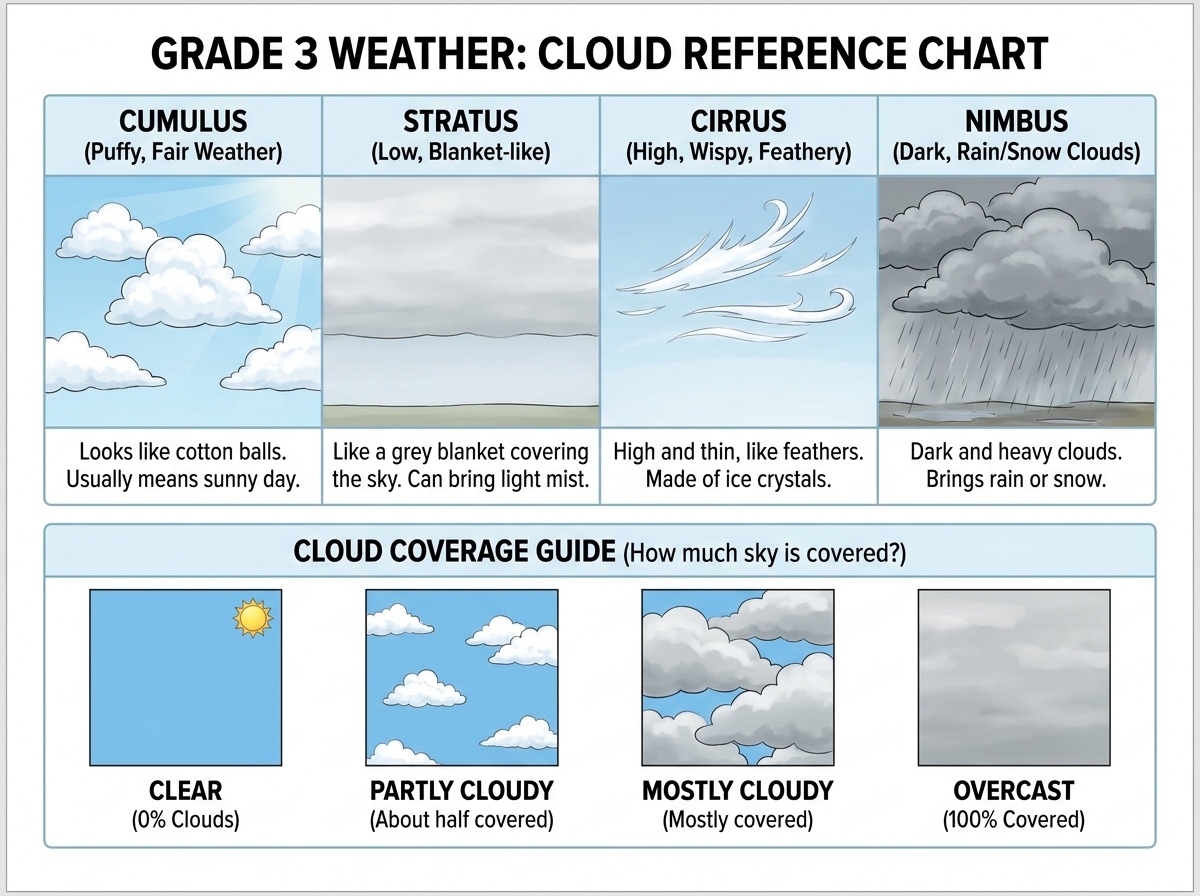
Use more specific weather words Instead of only saying cloudy or windy, encourage students to describe the sky more like a scientist: cloud type, cloud coverage, wind speed, wind direction, and precipitation.
Cloud types and cloud coverage guide for weather observations.
Sample 5-Day Weather Record
Day
Temp.
Cloud Type
Cloud Cover
Wind
Precipitation
Mon
68°F
Cumulus
Partly cloudy
Slow, from the west
0 mm
Tue
70°F
Cumulus
Partly cloudy
Slow, from the west
0 mm
Wed
66°F
Nimbus
Mostly cloudy
Fast, from the south
4 mm rain
Thu
63°F
Nimbus
Overcast
Fast, from the south
7 mm rain
Fri
65°F
Stratus
Mostly cloudy
Slow, from the north
1 mm drizzle
Let's Get Started
Step 1 — Go outside and notice the weather for today (5 min) If the weather allows, step outside briefly and ask students to describe today like young meteorologists. Prompt for temperature or warm/cold, cloud type, cloud coverage, wind speed, wind direction, and precipitation instead of only broad words like cloudy or windy.
Step 2 — Read the included five-day weather record (10 min) Use the sample chart on this lesson page. Help students read the temperature, cloud type, cloud coverage, wind, and precipitation (rain, measured in millimeters when possible) across several days.
Step 3 — Build a simple weather vane and rain gauge (10 min) Make a simple weather vane by taping two straws into a T shape. Add a paper arrow to the horizontal straw, then balance the straw on a pencil or skewer secured upright in a ball of play dough. If you want to measure rain, use a plastic cup marked in millimeters as a simple rain gauge. See the simple weather vane sketch in the Parent/Teacher Notes for a quick visual.
Easy tool ideas: The paper arrow should point the direction the wind is coming from. If the weather vane is not a hit, students can still record wind as no wind, light wind, or strong wind. If you do not have an outdoor thermometer, students can write warm or cold in the temperature space.
Step 4 — Record evidence on the worksheet (10 min) Students use the sample weather record and any outside observations to complete the worksheet with specific evidence.
Step 5 — Explain the pattern out loud (10 min) Students share one complete sentence that names the pattern and the evidence that supports it, such as repeated cloud cover, changing temperature, or increasing precipitation.
Discussion Questions
Why is one weather observation not enough to show a pattern?A pattern needs more than one day of evidence.
What changed over the five days?Students might notice temperature, rain, clouds, or wind changes.
What stayed the same over the five days?Students may notice repeated clouds, repeated afternoon rain, or similar temperatures.
How do your observations help you describe the weather more clearly?Observations give evidence instead of a guess.
Extensions
Extension: Keep a family weather chart for three more days and see whether the same pattern continues.
Parent/Teacher Notes
Teaching move: Push students to use the weather record itself as evidence instead of relying on memory alone.
Important misconception to catch: A pattern does not mean every day looks exactly the same. A pattern can include changes that repeat in a recognizable way.
Simple weather vane sketch:
paper arrow
<----------------->
straw
|
|
pencil or skewer
|
|
ball of play dough
Tape two straws into a T shape, attach a paper arrow to the top straw, and balance it on a pencil or skewer standing in play dough.
Use the sample weather record on this lesson page. Write specific observations, not vague words.
Day
Temp. or Warm/Cold
Cloud Type + Cloud Cover
Wind
Precipitation (rain, mm)
What pattern do you notice?
Day 1
Day 2
Day 3
Day 4
Day 5
2️⃣ Name a Pattern
Write one weather pattern you can support with evidence from the record.
3️⃣ Use Evidence
Which observations prove your pattern? Include details like cloud type, cloud coverage, wind, temperature, or precipitation.
🔑 PARENT ANSWER KEY — Detach before giving worksheet to students
1️⃣ Read the Weather Record — Sample Acceptable Answers
Students should use the sample chart on this lesson page and name specific observations such as cumulus clouds, overcast skies, fast wind from the south, or 4 mm of rain.
2️⃣ Name a Pattern — Sample Idea
“The weather became cooler and wetter over the five days.” or “Three days in the middle of the week were cloudy and rainy.”
3️⃣ Use Evidence — Sample Idea
Students should point to specific days and observations, such as repeated rain, lower temperatures, or stronger wind later in the week.
✅ What Success Looks Like
Student uses more than one day of evidence.
Student names a short-term weather pattern clearly.
Student supports the pattern with specific observations.
🛠️ Troubleshooting / Teaching Notes
If a student only says “it changed,” ask what changed and on which days.
If a student confuses a pattern with a prediction, remind them this lesson is about describing evidence we already have.
🥼
This is a preview. Unlock the full lesson.
You're seeing a preview. Full-library access is not live yet. For now, browse the live store products and free sample lessons while the larger subscription offer stays in Coming Soon. Live now: free samples + Kitchen Chemistry.