Earth Science — Weather Detectives & Wild Storms | Unit 1, Lesson 1 of 6
📚 Grade: 2nd Grade⏱️ Duration: 50–60 minutes🌎 Subject: Earth Science — Weather🧪 Hands-on Hook: Build a mini weather station
🌬️🌧️📏☁️
Meteorologists do not just guess — they build tools, collect evidence, and compare patterns.
📋 NGSS-aligned focus:
Planning and carrying out investigations, using tools to gather data, and analyzing weather patterns using evidence over time.
🎯 Learning Objective
Students will build simple weather-observation tools, collect a first set of weather data, and explain why repeated measurements help meteorologists describe and compare local weather.
💡 The Big Idea
Weather is more than a feeling like “nice” or “gross.” Scientists describe weather with evidence: how windy it is, how much rain fell, what the clouds look like, and how warm or cold the air feels. Tools help us notice those details carefully and consistently.
🔬 The Science
Meteorologists study weather by observing the atmosphere over and over. They do not rely on memory alone. Instead, they collect measurements and observations so they can compare one day to the next. A windy day feels different from a calm day, but a windsock helps us describe that wind more clearly. A rainy day looks obvious while it is raining, but a rain gauge tells us how much precipitation actually fell.
In Grade 2, the important lift is moving from “I saw clouds” to “I can describe what I observed and compare it to tomorrow.” That is real science thinking. The goal is not perfect professional equipment. The goal is using simple tools in a careful way so patterns become visible.
1 index card or small piece of cardboard for a cloud viewer frame
Paper and crayons
Optional: outdoor thermometer
📄 Printables
Student worksheet page from this lesson
🧭 Build Your Weather Station
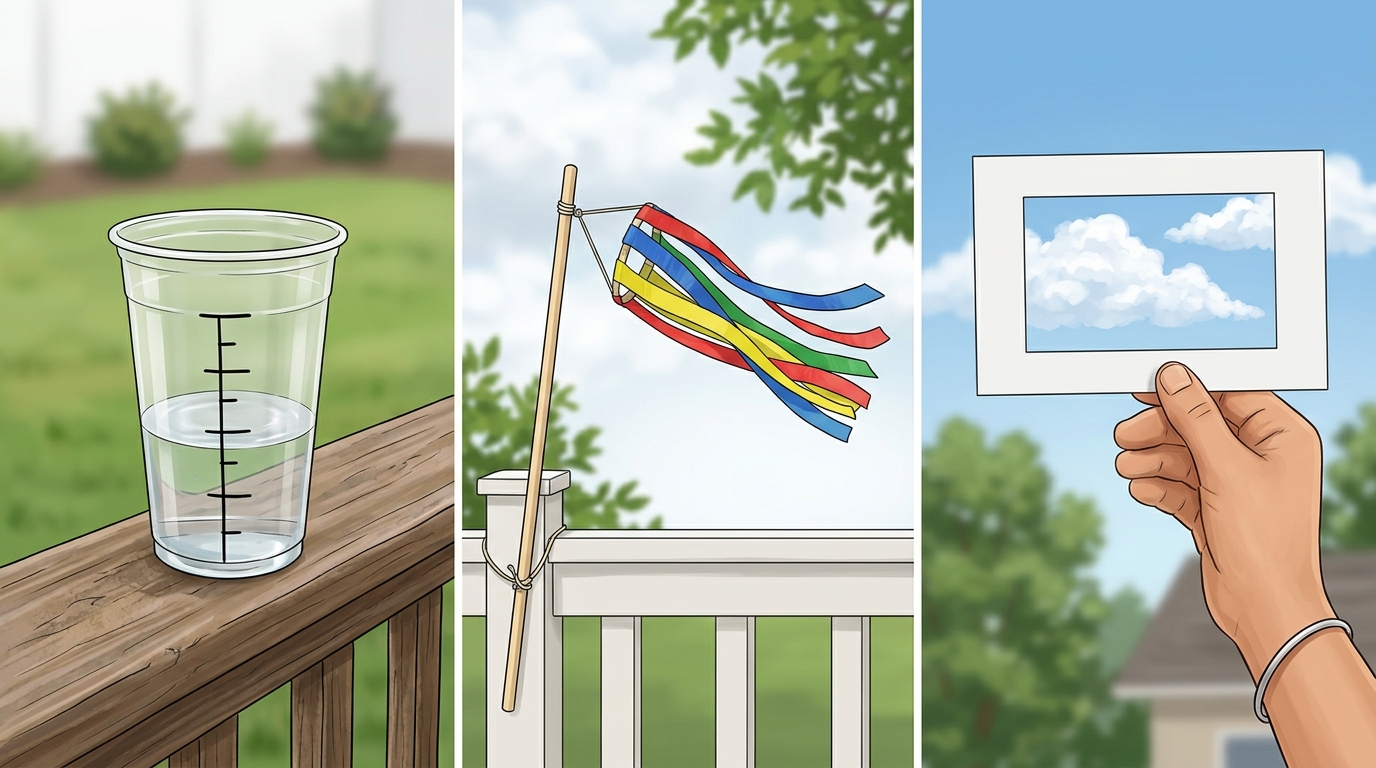
Rain gaugeUse a clear cup. Mark a few simple measurement lines with a ruler so you can tell whether rain collected a little or a lot.
WindsockTape a paper strip or ribbon to a pencil, stick, or porch rail. Watch whether it hangs down, waves a little, or stretches out strongly.
Cloud viewer frameCut a simple window into an index card or small piece of cardboard. Hold it up to the sky to focus on one patch of clouds at a time.
What students are building
These illustrations show the three tools more clearly: a rain gauge made from a marked cup, a ribbon windsock tied to a stick or rail, and a cloud viewer frame cut from an index card.
🔍 Let’s Get Started
Step 1 — Launch the mystery: Ask, “If two people both say ‘It’s windy,’ how could a scientist make that more exact?” Explain that today the child becomes a meteorologist.
Step 2 — Make a simple rain gauge: Use the ruler to mark equal lines on the side of a clear cup or jar. Label them 1, 2, 3, and 4. Place the cup outside in an open spot where it can collect rain safely.
Step 3 — Make a windsock or wind ribbon: Tape a paper strip or ribbon to a stick, pencil, porch rail, or fence. Observe whether it hangs down, wiggles lightly, or stretches strongly in one direction.
Step 4 — Make a cloud viewer frame: Cut a window into an index card or small piece of cardboard. Hold it up to the sky to focus on one section and decide whether the clouds look clear, partly cloudy, mostly cloudy, or stormy.
Step 5 — Record a first observation: Go outside or look from a safe window. Record cloud cover, wind strength, temperature feel, and whether any precipitation is happening right now.
Step 6 — Compare evidence types: Ask which tool helped with wind, which helped with rainfall, and which helped with cloud cover.
Step 7 — Start the pattern habit: Tell the child to repeat the observation at the same time for the next two days. The power comes from doing it more than once.
💬 Discussion Questions
Why do scientists use tools instead of only saying “It feels rainy” or “It feels windy”?Look for: tools help us gather clearer evidence and compare one day to another.
Which part of weather was easiest to observe today? Which part was hardest?Look for: clouds are visible, but wind is easier to notice with a ribbon or windsock.
Why should we observe at the same time each day if we want to compare patterns?Look for: it makes the observations fairer and more consistent.
If your rain gauge stays empty, does that mean the lesson failed?Look for: no — “no rain” is still data, and scientists record what really happened.
🌟 Extension
Extra challenge: Add a simple compass direction to your wind notes. Is the ribbon being pushed toward the east, west, north, or south?
Gifted extension: Compare your data with a weather app or local forecast. Where do your observations match? Where is the app more exact?
👩🏫 Parent / Teacher Notes
This lesson is stronger than Kindergarten weather observation because the child is building tools and using repeated evidence, not only naming the weather.
If there is no rain this week, that is fine. The rain gauge still matters because it teaches what evidence collection looks like.
If you own a real thermometer, add it. If not, “cold / cool / warm / hot” is enough for Grade 2.
Keep the tools simple. A child-made tool that gets used is better than a perfect tool that never goes outside.
Draw your tools here. Label the rain gauge, wind tool, and cloud viewer frame.
3️⃣ My First Weather Observation
Wind
Cloud cover
Temperature feel
Precipitation
4️⃣ Three-Day Pattern Tracker
Day
What stayed the same?
What changed?
Day 1
Day 2
Day 3
5️⃣ Scientist Thinking
Why is “no rain today” still useful data?
✂️ Parent Answer Key — Detach Before Giving Worksheet to Students
1️⃣ My Weather Tools
Accept any honest record of the tools built. Strong answers name how the tool helped: for example, “The ribbon helped me see that the wind changed direction.”
2️⃣ Draw Your Weather Station
Look for a labeled sketch showing where the rain gauge and wind tool were placed and where the child observed the sky.
3️⃣ First Weather Observation
Answers vary by actual conditions. Accept category words such as calm / breezy / strong wind, clear / partly cloudy / cloudy, cool / warm / hot, and none / rain / snow.
4️⃣ Three-Day Pattern Tracker
There is no single right answer. A strong response notices one repeated feature and one change, such as “The sky stayed mostly cloudy, but the wind got stronger on Day 3.”
5️⃣ Scientist Thinking
Expected idea: “No rain” still tells us what happened and helps us compare different days. Scientists record all observations, not only exciting ones.
✅ What success looks like
The child built at least one simple observation tool.
The child recorded a first weather observation using categories or evidence words.
The child shows understanding that repeated observations reveal patterns.
🥼
This is a preview. Unlock the full lesson.
You're seeing the opening pages of this lesson. Browse the bundle lineup, compare free lessons, and request launch access for the units your family wants first.