📚 Grade: 1st Grade⏱️ Duration: 45 minutes🔬 Subject: Life Science — Animal Structures📖 Lesson: 6 of 6 ⭐
🐠🦅🐒🐾🐪
Water, air, underground, treetops, desert — every environment has an animal perfectly built to move through it!
📋 NGSS Standard: 1-LS1-1 — Use materials to design a solution to a human problem by mimicking how plants and/or animals use their external parts to help them survive, grow, and meet their needs.
🎯 Learning Objective
Students will identify structural adaptations for movement in different environments and design an original animal with structures suited to a specific environment.
💡 The Big Idea
Moving around is essential for survival — animals need to find food, escape predators, find mates, and reach shelter. Different environments demand completely different movement strategies. The structures that make a fish an effortless swimmer would be useless underground. The paws that make a mole a perfect digger would slow it down in water. Every environment shapes its animals to move through it efficiently.
Paper and crayons or markers (for the animal design challenge)
Colored pencils — optional, for more detailed animal designs
✅ Paper and crayons — that's all! The creativity is the activity.
🔬 Part 1 — Five Environments, Five Solutions (15 min)
Each environment presents a different movement challenge. Study how animals solved each one.
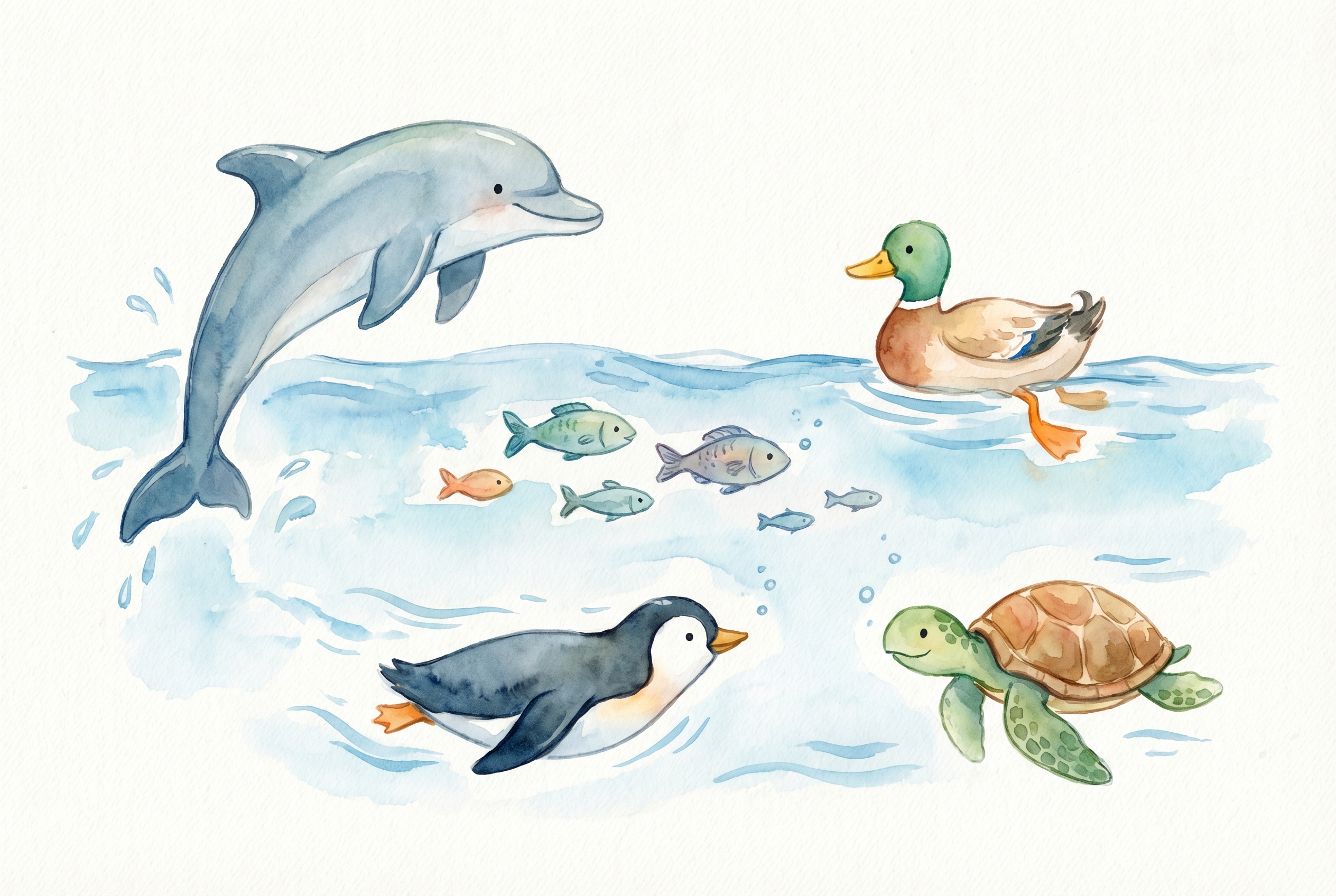
Water
Fish, dolphin, duck, penguin, sea turtle
Streamlined body — tapered front to back, reduces drag as water flows past Fins — push against water to steer and propel forward Paddles (ducks, penguins) — webbed feet act like oars for surface swimming Flippers (sea turtles, seals) — like wings, "fly" through water
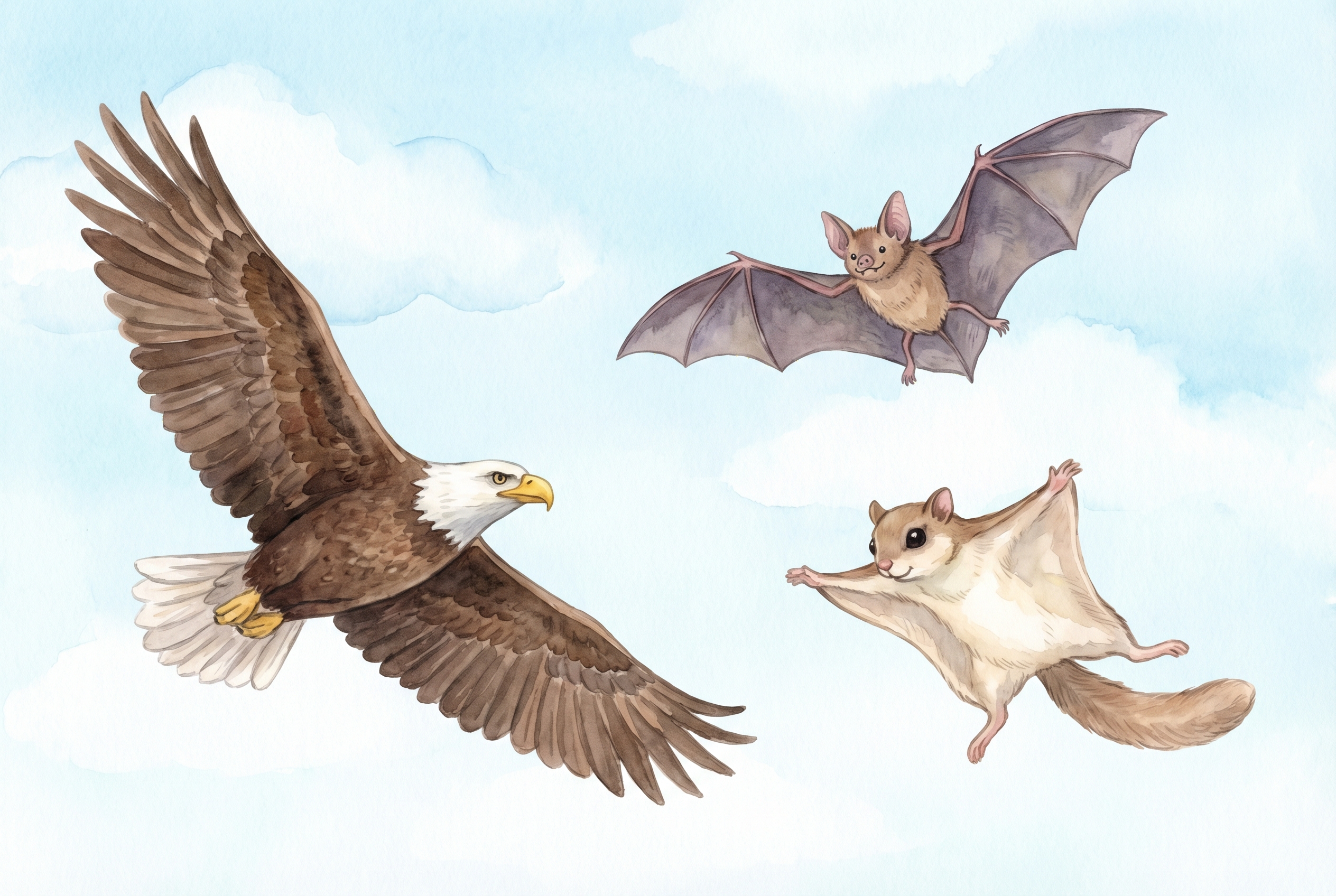
Air
Eagle, bat, flying squirrel, sugar glider
Feathered wings (birds) — rigid yet flexible, generate lift and thrust Membrane wings (bats) — skin stretched between long arm and finger bones, incredibly maneuverable Gliding membranes (flying squirrel) — stretched skin between front and back legs acts as a parachute — glides but can't truly fly
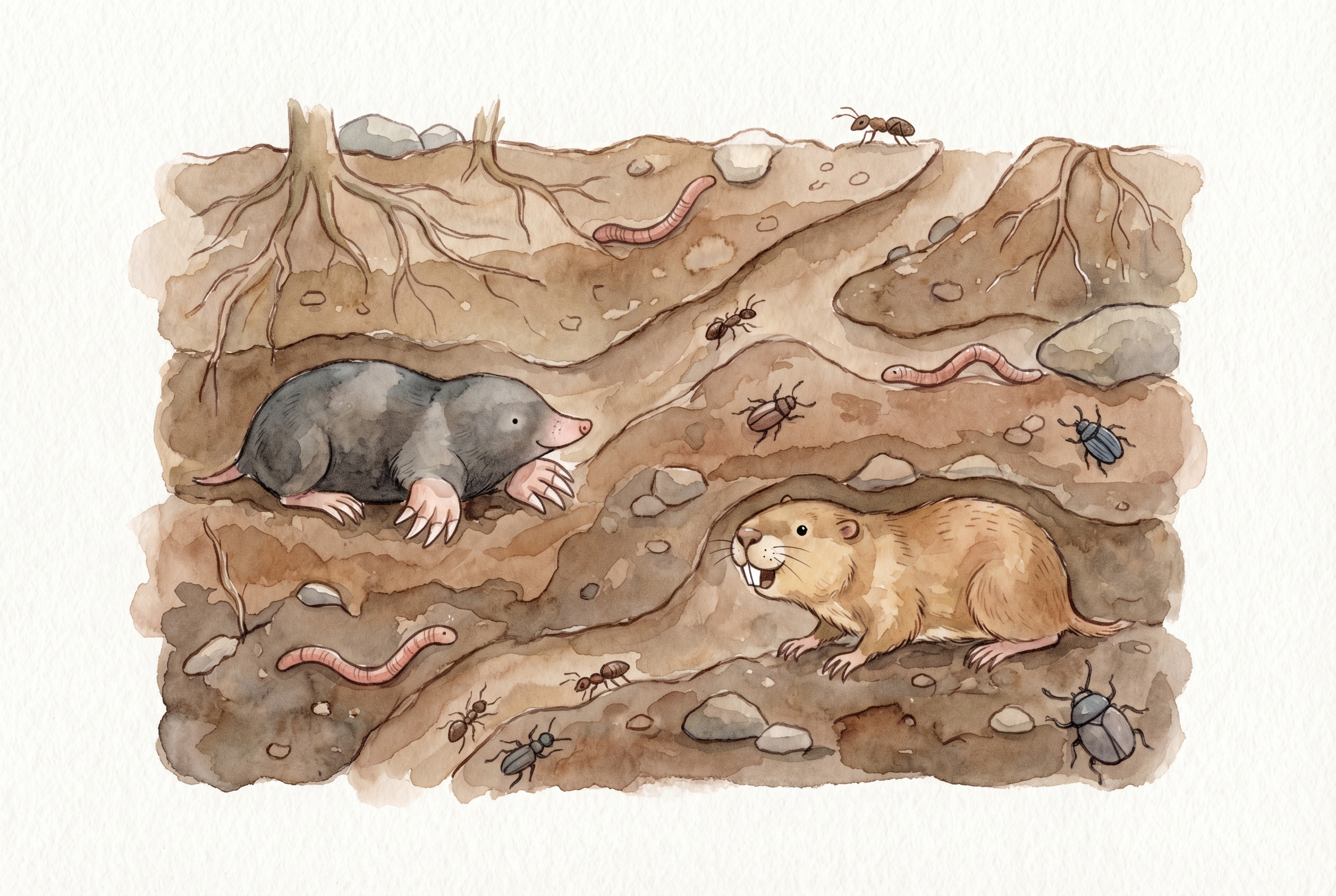
Underground
Mole, gopher, naked mole rat, earthworm
Powerful front legs — built for digging, like shovels with muscles Shovel-shaped paws — broad, flat hands with extra bone (a "sixth finger") to scoop soil Tiny or no eyes — useless underground, replaced by sensitive nose and whiskers Compact body — fits through narrow tunnels
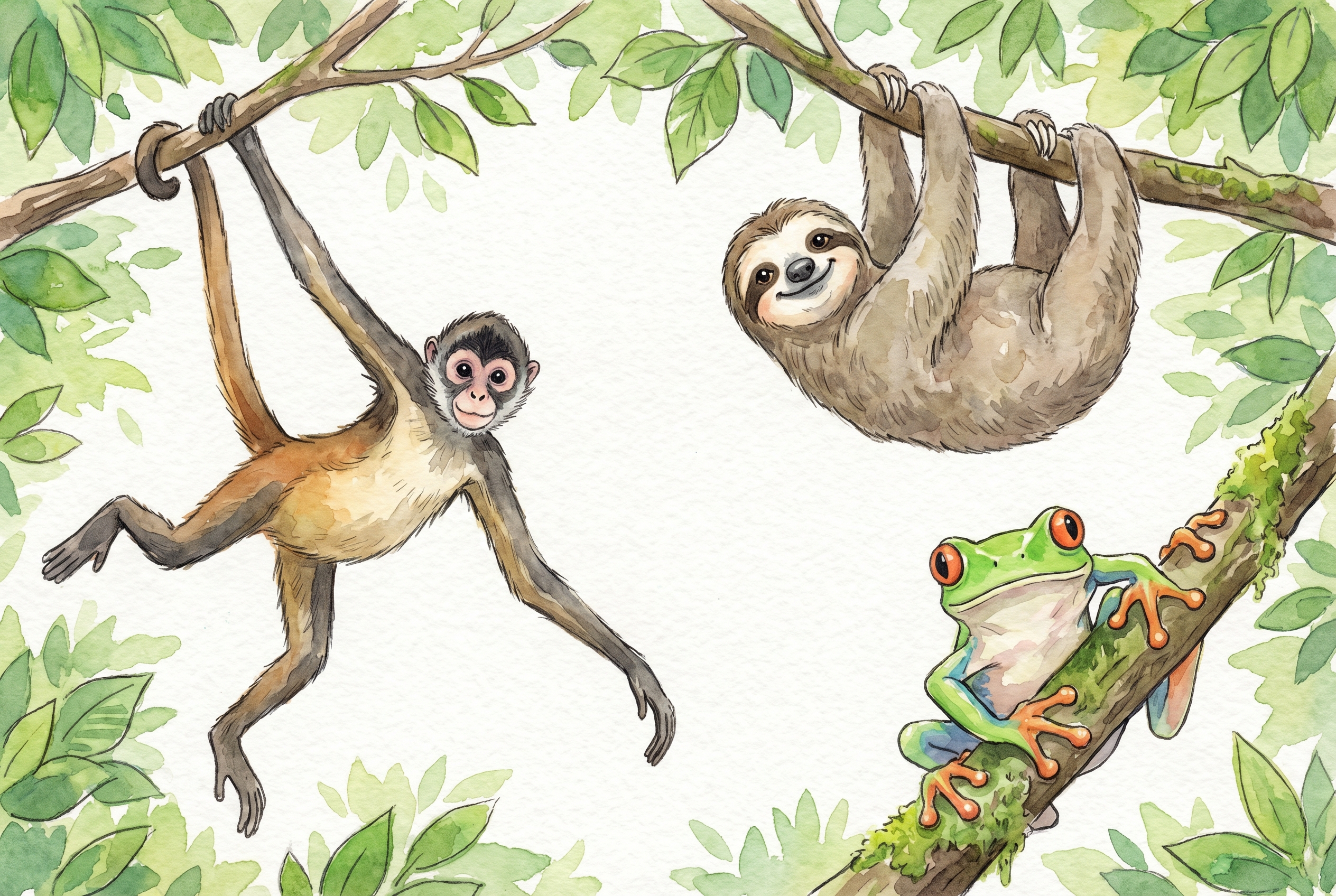
Treetops
Spider monkey, sloth, chameleon, tree frog
Grasping hands and feet — opposable thumbs wrap around branches Prehensile tail (spider monkey) — acts as a fifth arm, wraps around branches for anchor Sticky toe pads (tree frog) — microscopic suction cups grip any surface Long arms and legs — reach gaps between branches
Desert Sand
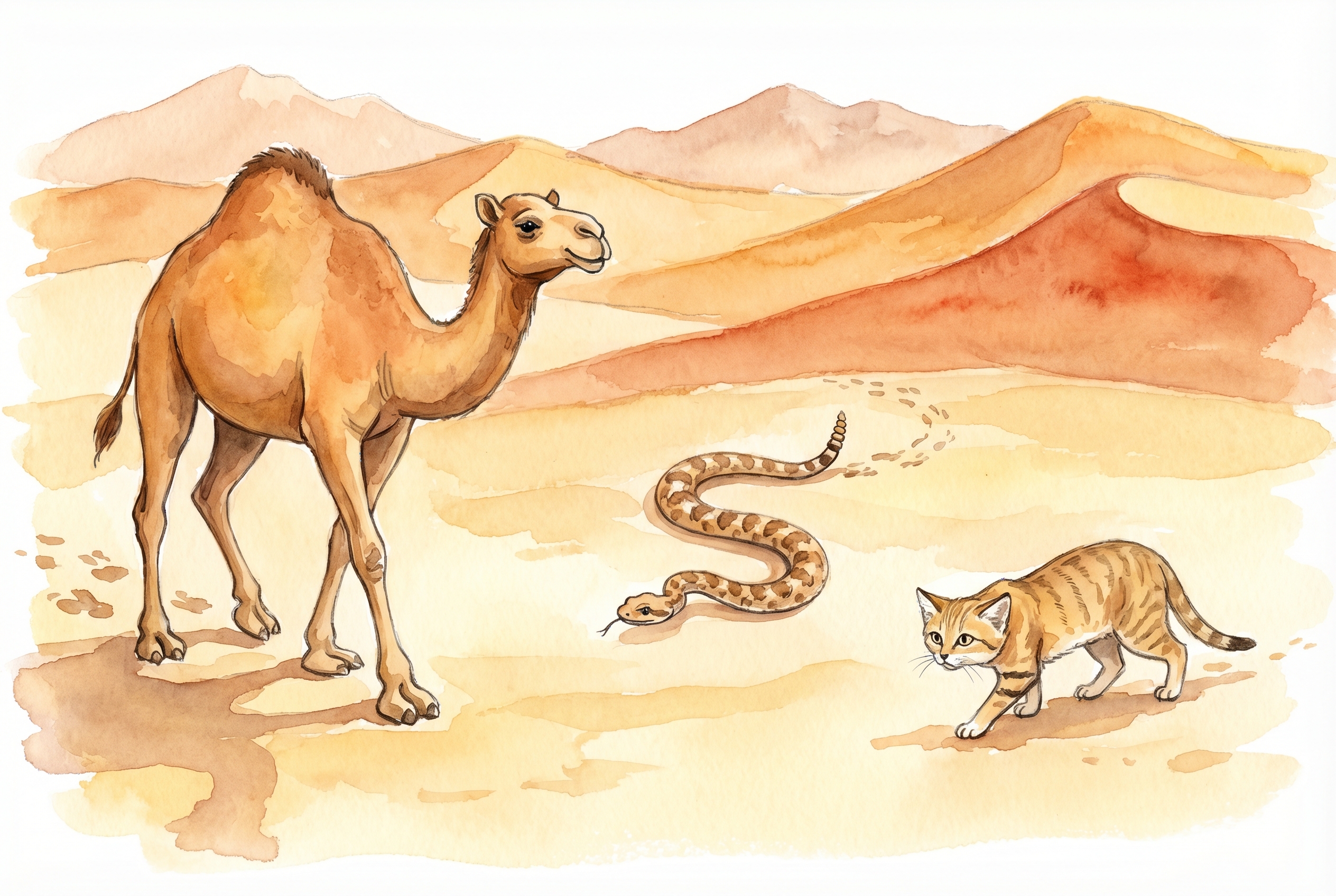
Camel, sand cat, shovel-nosed snake, sandgrouse
Wide, splayed toes (camel) — distribute weight across soft sand, like built-in snowshoes (sand shoes!) Padded feet (camel) — thick leathery sole protects from burning hot sand Lateral undulation (sidewinder snake) — moves sideways to minimize contact with hot sand Sand-colored coat — camouflage and heat reflection in desert light
Discussion during Part 1:
"Could a mole survive in the ocean? Why not?"
"Birds and bats both fly — how are their wings different? Same job, different structure!"
"What do a spider monkey's tail and a rock climber's rope have in common?"
Hands-On Test — Water Resistance (5 min): Fill a bowl with water. Try pushing a flat piece of cardboard through it, then a pointed cone shape. Ask: "Which moves more easily?" Connect that back to why fish and dolphins have streamlined bodies for moving through water.
Hands-On Test — Prehensile Tail Challenge (3 min): If safe, have students hang from their arms for 30 seconds and notice how hard their muscles work. Then connect that feeling back to spider monkeys using a powerful tail like an extra gripping tool while moving through treetops.
🏗️ Part 2 — Design Your Own Animal (20 min)
🎨 Engineering Challenge: Invent an Animal!
Pick one environment for your animal to live in:
🌊
Deep Ocean
🌿
Dense Jungle
❄️
Frozen Tundra
🏜️
Hot Desert
Draw your made-up animal and label at least three structural adaptations that help it move through that environment. For each one, explain why that structure helps in that environment.
Bonus challenge: Give your animal a name and explain what it eats and what it must escape from!
Step-by-Step Guide for Part 2:
Review the five environments and their movement solutions together.
Student picks one environment. Discuss: what challenges does movement in that environment have?
Student draws an original animal designed for that environment.
Label at least 3 structural adaptations for movement — with a reason for each.
Share with the family: "My animal lives in ___. It can move there because ___."
💬 Discussion Question
🗣️ Big Question: "Birds and bats both fly — but their wings are completely different. How can two animals solve the same problem in different ways?"
Suggested answer: This is called convergent evolution — different animals, starting from different ancestors, arriving at similar solutions to the same problem. Bird wings evolved from scaly dinosaur arms; bat wings evolved from mammal hands with skin stretched between elongated fingers. They solve the same problem (powered flight) with different structural approaches. Bird wings use stiff, lightweight feathers that can be rearranged for different flight modes. Bat wings use flexible skin membranes that make bats extraordinarily maneuverable at low speeds — perfect for catching moths in cluttered spaces. Nature doesn't have just one answer to "how do you fly?" — it has many! This same principle shows up everywhere: eyes evolved independently in vertebrates and in octopuses, even though they look remarkably similar. When the same solution keeps appearing independently, it's a sign that it's a very good solution to a real problem.
🚀 Extensions
🦇 Bat vs. Bird Wings: Look up pictures of a bird wing skeleton and a bat wing skeleton side by side. Both are modified forelimbs — both have a "shoulder," "elbow," and "wrist" — but the finger bones in bats are elongated to support the wing membrane. Extraordinary!
📚 Read Aloud:"Move!" by Steve Jenkins and Robin Page (features exactly this topic!)
❄️ Tundra Animal Research: The Arctic fox has fur on the bottom of its paws — the only dog family member with this feature. Why? Hot pavement burns paws; frozen tundra freezes them. The foot-fur is insulation for walking on ice. How else do Arctic animals adapt for movement in frozen environments?
👩🏫 Parent/Teacher Notes
Convergent evolution note: The "birds and bats" discussion opens the door to convergent evolution. This is a rich idea for curious students: the same selective pressure (needing to fly, needing to swim fast) tends to produce similar solutions. Dolphins and sharks look similar but are not closely related — both evolved streamlined bodies for fast swimming. Shrews and moles look similar but are only distantly related — both evolved compact burrowing bodies. The same environment pulls animals toward similar solutions.
Mole anatomy: Moles have a remarkable extra bone in their front paws — technically a sesamoid bone in the wrist that functions like a sixth finger, dramatically increasing the scoop surface. This is a beautiful example of how evolution can produce novel structures to solve specific problems.
Flying squirrel vs. bat distinction: Flying squirrels don't truly fly — they glide. They can't gain altitude; they can only extend a downward trajectory. Bats can truly fly, gaining altitude by flapping. This is a meaningful distinction for curious students.
Design challenge freedom: The "make your own animal" activity should be open-ended and celebrated. There's no wrong answer as long as the structural adaptations are logically connected to the environment. A student who designs a deep-ocean creature with bioluminescent stripes for seeing in the dark and webbed feet for swimming is doing real scientific thinking!
Desert sand note: A camel's foot pad covers an area roughly equivalent to a dinner plate. This distributes the camel's 1,500 lb weight so its pressure per square inch on sand is actually lower than a human's feet. Truly remarkable engineering!
Part 1 — Matching: Animal to Its Movement Environment
Draw a line from each animal to where it moves best!
🐠Fish (streamlined body + fins)
🦅Eagle (feathered wings)
🐾Mole (shovel paws)
🐒Spider monkey (prehensile tail)
🐪Camel (wide splayed toes)
🌴 Treetops
🏜️ Desert sand
🌊 Water
🌤️ Air
🌍 Underground
Part 2 — Design Your Animal!
Pick an environment and design an animal built to move in it. Label at least 3 adaptations!
My environment is: ___________________________ My animal's name: ___________________________
✏️ Draw your original animal here...
Adaptation 1:
Why it helps:
Adaptation 2:
Why it helps:
Adaptation 3:
Why it helps:
Part 3 — Think About It!
A bird and a bat both fly. How are their wings different?
✂️ PARENT ANSWER KEY — Detach before giving worksheet to students
Part 1 — Matching Answers
🏃 Animal → Environment
🐠 Fish → Water 🌊
🦅 Eagle → Air 🌤️
🐾 Mole → Underground 🌍
🐒 Spider monkey → Treetops 🌴
🐪 Camel → Desert sand 🏜️
💡 Part 3 — Think About It!
Bird wings have feathers; bat wings have skin membranes
Bat wings are stretched between finger bones; bird wings use stiff flight feathers
Accept: "bats have skin between their fingers, birds have feathers"
Both work for flying — different structures, same function
Part 2 — Design Challenge — What to Look For
Animal clearly lives in the chosen environment
At least 3 structural adaptations are labeled
Each adaptation has a reason connected to movement in that environment
Student can verbally explain their animal's design choices
Designs are evaluated on logic of connection between structure and function — not artistic quality
✅ Unit Completion — What Success Looks Like
Student correctly matches all 5 animals to their environments
Student's design shows 3+ labeled adaptations with reasons
Student can explain: "birds and bats both fly but have different wing structures"
Student can make the connection across the unit: structure → function → survival
💡 Unit reflection conversation: Ask your student: "If you could have any one animal superpower from this whole unit — a shell, quills, photosynthesis, echolocation, a prehensile tail — which would you pick and why?" There's no right answer — just great thinking about structure and function!

 Water
 Air
 Underground
 Treetops
 Desert Sand