Animals already solve real problems with their body parts. Engineers can borrow those ideas.
📋 NGSS Standard: 1-LS1-1 — Use materials to design a solution to a human problem by mimicking how plants and/or animals use their external parts to help them survive, grow, and meet their needs.
🎯 Learning Objective
Students will notice how animal body parts do important jobs, match each structure to the problem it solves, and choose one idea a human tool could copy.
💡 The Big Idea
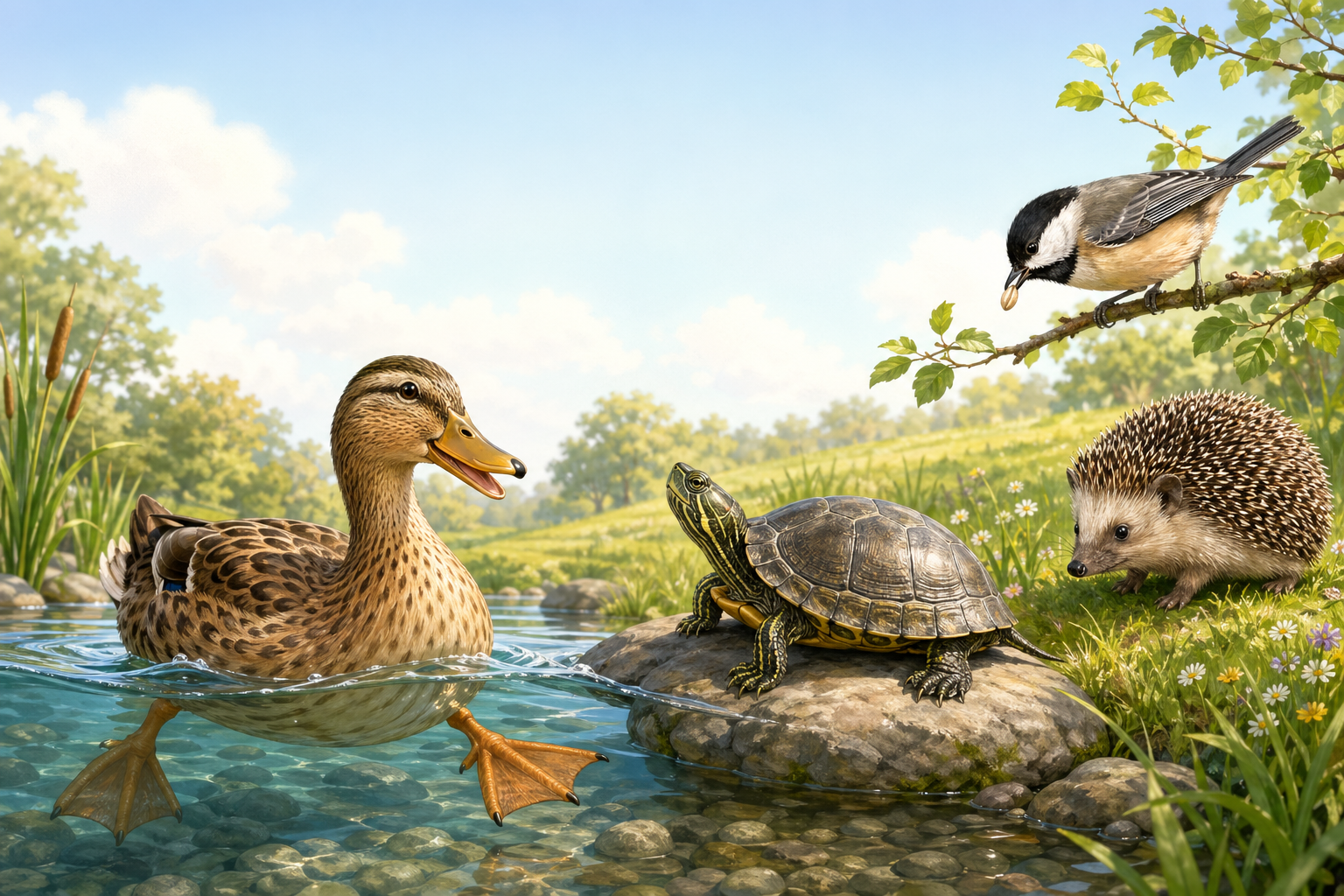
Animals do not have tools from a store, but they still solve problems every day. A duck's webbed feet help it move through water. A turtle's shell helps protect its body. A bird's beak helps it pick up food. Engineers look at helpful structures like these and ask, "Could we copy that idea to help a person?"
🎯 Success rule: By the end of the lesson, your child should be able to say: "This animal part helps with ___. A human tool could copy it to help with ___."
🔬 The Science + Engineering Connection
In this unit, children are not just naming animal parts. They are learning to think like little engineers. First they look closely at nature. Then they figure out what job a body part does. Then they borrow the useful idea. That is called mimicking nature.
For first grade, the important thinking move is simple: body part → job → tool idea. If children can make that chain clearly, they are doing the real work of the standard.
📦 Materials
Pencil and crayons
Worksheet pages from this lesson
Optional: toy animals, animal photos, or a nature book
Optional: one spoon, one mitten, one umbrella, and one kitchen tongs/grabber for quick comparison examples
👀 Animal Solution Gallery
🦆
Duck Feet
Job: Push water and help the duck swim.
Human idea: Swim fins or flippers that help people move in water.
move through water
🐢
Turtle Shell
Job: Protect the turtle's soft body.
Human idea: Helmet, knee pads, or a hard case that protects something fragile.
stay safe
🐦
Bird Beak
Job: Pick up, grab, or crack food.
Human idea: Tongs, grabbers, or a picker tool.
pick up and grab
🦔
Hedgehog Spines
Job: Help protect the hedgehog from danger.
Human idea: Protective outer covering or gear that keeps someone safer.
protect from harm
🔬 Let's Get Started
Step 1 — Notice the Problem Each Animal Solves (8 min) Look at the Animal Solution Gallery together. For each animal, ask: "What is hard in this animal's world?" Then ask: "What body part helps?" Keep it concrete: water, danger, reaching food, carrying or moving.
Step 2 — Act It Out (8 min) Let your child pretend to be each animal. Push hands like duck feet, curl up like a turtle hiding in a shell, pinch fingers like a beak, and freeze like a hedgehog protecting itself. The goal is to feel the job, not just hear about it.
Step 3 — Match Structure to Job (8 min) Use the worksheet table to match each animal part with what it helps do. If your child gets stuck, return to the sentence frame: "This part helps it ___."
Step 4 — Borrow One Good Idea (8 min) Ask: "Which animal idea would help a person the most?" Pick just one. Have your child explain what tool could copy that idea and what the tool would help someone do.
Step 5 — Sketch Tomorrow's Tool Idea (5–8 min) End by drawing one simple tool idea. Tomorrow's planning lesson will build from this choice, so what matters today is a clear idea, not a perfect drawing.
💬 Teaching tip: If a child starts describing only what the tool looks like, gently pull them back to the job: "What would it help a person do?" That is the important engineering move here.
💬 Discussion Questions
🗣️ Which animal part seemed most helpful?
💬 Listen for a real job: swim faster, stay safe, pick up food, or protect the body.
🗣️ What problem does that body part solve?
💬 Strong answers sound like: “It helps the animal move in water,” not just “It has feet.”
🗣️ What human tool could copy that idea?
💬 A strong answer explains both the copied part and the job the tool would do.
🗣️ Why do engineers study animals and plants?
💬 Nature already has lots of smart solutions. Engineers learn from those ideas.
👩🏫 Parent/Teacher Notes
Keep it physical: This lesson works better when children point, act, and compare—not just listen.
Keep the language simple: “Copy an idea from nature” is better than overloading first graders with technical wording.
Do not rush to building yet: Today's job is to choose a strong nature idea worth copying.
What mastery looks like: A child can say what the body part does and name a sensible human tool idea inspired by it.
Helpful correction: If a child says “The tool should look like a duck,” redirect to function: “What should it help someone do?”
I want to copy the ________________________________ because it helps with ________________________________.
3️⃣ My human tool idea
My tool would help a person ______________________________________________.
It would copy the animal part by ___________________________________________.
4️⃣ Draw your tool idea
Draw your nature-inspired tool here ✏️
🔑 PARENT ANSWER KEY — Detach before giving worksheet to students
Expected matches
Duck feet: help push through water / help the duck swim
Turtle shell: helps protect the turtle
Bird beak: helps pick up or crack food
Hedgehog spines: help protect the hedgehog from danger
Sample strong response
I want to copy a bird beak because it helps pick things up. My tool would help a person grab trash or blocks without using their fingers. It would open and close like a beak.
✅ What success looks like
Student connects a real animal part to a real job.
Student chooses a human tool idea that copies the useful feature.
Student explains the job of the tool, not just how it looks.